ABT ASSOCIATES
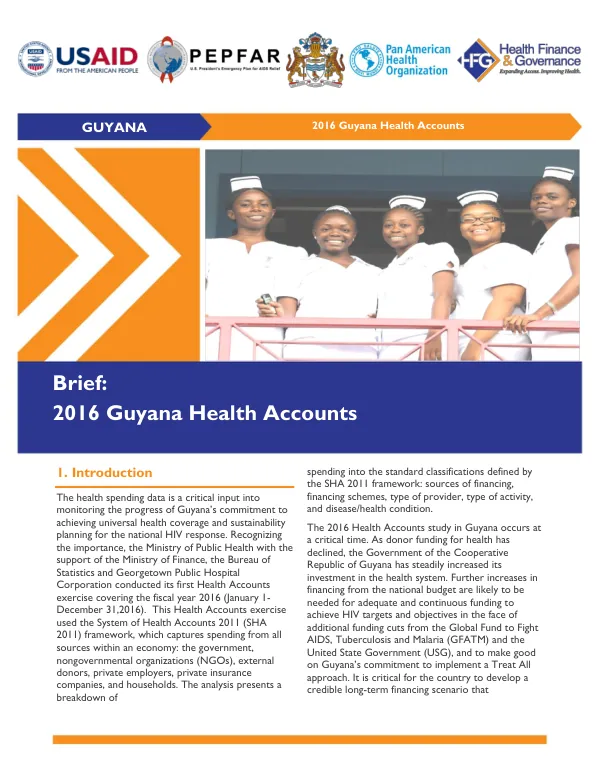
Guyana 2016 Health Accounts Statistical Report
Guyana's 2016 Health Accounts study aimed to track the country's health expenditures using the internationally recognized System of Health Accounts (SHA) 2011 framework.
2018 · 48 pages
Sign in to readA free account is required to download.
Abstract
The study collected health spending information from various sources, including the government, households, non-governmental organizations, employers, insurance companies, and donors. The results provided key information on a health system's financing, including who pays for health care goods and services, who manages health financing flows, and what health care goods and services are provided. The SHA 2011 framework was created in 2011 and built on previous international guidelines and manuals for tracking health expenditures. It provides a standardized and internationally recognized framework that allows countries to compare their Health Accounts results with one another and with different years. Guyana's 2016 Health Accounts exercise used this framework to collect and analyze health spending data. The study began in June 2017 with the formation and training of the Health Accounts Technical Team, led by the Guyana Ministry of Public Health (MOPH). The Technical Team comprised representatives from the MOPH, the National Insurance Scheme (NIS), the Ministry of Finance (MOF), the Pan American Health Organization (PAHO), and Georgetown Public Hospital Corporation (GPHC). USAID's Health Finance and Governance Project provided support to the Technical Team. The study collected data from various sources, including primary institutional data sources, household data, and secondary data sources. The data analysis involved double-counting, estimation, and application of distribution keys, as well as the use of the Health Accounts Production Tool (HAPT). The study also identified potential health questions for future household surveys in Guyana. The results of the study provided critical information on Guyana's health system financing, including the revenues of financing schemes, institutional units providing revenues to financing schemes, and health care providers. The study also provided detailed information on the health care functions, financing schemes, and health care providers for specific diseases and health conditions, such as HIV and AIDS. The study's findings have important policy implications for Guyana's health system financing. The results can inform future Health Accounts studies in Guyana and provide critical information for government health financing technicians and researchers. The study's methodology and results can also be used to track Guyana's progress and compare the various studies' results over time. The study's data limitations and recommendations are discussed in detail in the report. The report also provides a list of tables and acronyms used in the study. The acronyms include terms such as AIDS, ART, BOS, CHE, DHS, FA, FP, FS.RI, FS, GPHC, GDP, HBS, HF, HAPT, HC, HIV, HP, IEC, MOF, MOPH, NCD, n.e.c., NGO, NIS, NPISH, OOP, PAHO, PEPFAR, SHA, THE, USAID, and VCT. Overall, Guyana's 2016 Health Accounts study provides critical information on the country's health system financing and can inform future Health Accounts studies in Guyana. The study's methodology and results can also be used to track Guyana's progress and compare the various studies' results over time.