ABT ASSOCIATES
Trinidad and Tobago Health Accounts 2015: Key Findings and Policy Implications
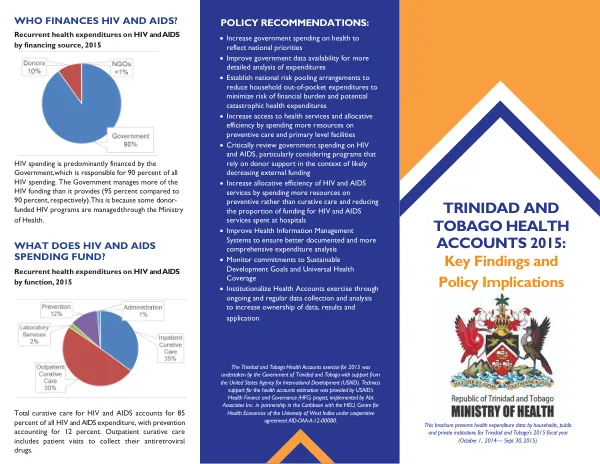
The Government is the largest contributor to health spending in Trinidad and Tobago, accounting for 90 percent of all HIV spending.
2015 · 2 pages
Sign in to readA free account is required to download.
Abstract
The Government manages more of the HIV funding than it provides, with 95 percent of funding being managed compared to 90 percent provided. This is due to some donor-funded HIV programs being managed through the Ministry of Health. Total curative care for HIV and AIDS accounts for 85 percent of all HIV and AIDS expenditure, with prevention accounting for 12 percent. Outpatient curative care includes patient visits to collect their antiretroviral drugs. The majority of expenditures could not be attributed to one disease or health condition due to the current Health Information Management System. The Government is the biggest contributor to health spending, followed by households through out-of-pocket payments. 21 percent of recurrent health expenditure is spent on noncommunicable diseases (NCDs), with the top three funded NCDs being sense organ diseases, oral diseases, and mental and behavioral diseases and neurological conditions. Spending for HIV and AIDS accounts for less than 1 percent of all recurrent expenditure. Health spending in Trinidad and Tobago is predominantly for curative care, which includes all inpatient and outpatient care whose principal intent is to relieve symptoms of illness or injury. Spending on prevention represents 14 percent of recurrent health spending. The current Health Accounts exercise for 2015 was undertaken by the Government of Trinidad and Tobago with support from the United States Agency for International Development (USAID). The Health Accounts methodology is an internationally standardized approach used by countries to track funding flows through the health system in a given year. It measures how a country's health expenditure flows from financing sources to financing agents, healthcare providers, and health functions. Health Accounts data measure financial performance and answer key policy questions, making it a critical tool for policy analysis and strategic planning.