MINISTRY OF FINANCE
2016 Guyana Health Accounts
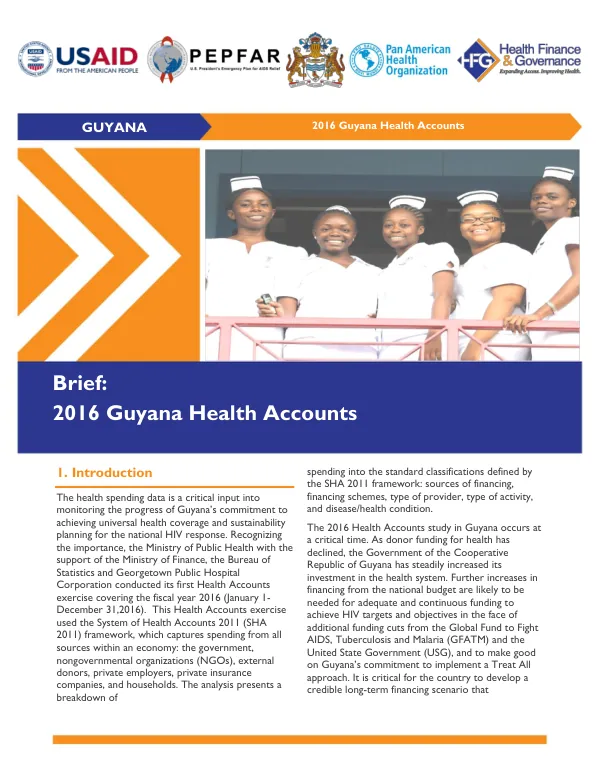
The 2016 Guyana Health Accounts study was conducted by the Ministry of Public Health, with the support of the Ministry of Finance, the Bureau of Statistics, and the Georgetown Public Hospital Corporation.
2016 · 8 pages
Sign in to readA free account is required to download.
Abstract
The study used the System of Health Accounts 2011 (SHA 2011) framework to capture spending from all sources within the economy, including government, nongovernmental organizations, external donors, private employers, private insurance companies, and households. The analysis presents a breakdown of spending into standard classifications defined by the SHA 2011 framework, including sources of financing, financing schemes, type of provider, type of activity, and disease/health condition. Total health expenditure (THE) in Guyana in 2016 amounted to G$28,595,303,655, of which 99 percent was current spending. The Government of the Cooperative Republic of Guyana made the largest contribution to health spending, accounting for 81 percent of the total spending. The substantial government contribution to health spending comprised 10 percent of the government's total spending in the fiscal year. Households, employers, and donors contributed 9 percent, 4 percent, and 6 percent, respectively. The majority of health funds were spent on public facilities, with 71 percent of health funds spent on public facilities (levels 1, 2, 3, and 4). Private facilities accounted for 7 percent of THE. The Government of Guyana spent 49 percent of its THE at public hospitals, and 39 percent of government THE was spent at the primary and secondary facility level (health centers and health posts). The majority of funds (64 percent) was spent on curative care, while 19 percent of funds were spent on preventive care. Administration consumed 8 percent of THE, and the purchase of pharmaceuticals accounted for 5 percent of THE. Non-communicable diseases received the highest allocation of funds, at 34 percent of THE, followed closely by infectious and parasitic diseases, at 29 percent (including HIV and AIDS). Within this, spending on HIV and AIDS represented 7 percent of THE. The government provides the majority of current health spending on HIV and AIDS, followed by donors (62 and 35 percent, respectively). NGOs, corporations, and households comprise the remaining sources. The majority of HIV and AIDS current spending goes towards prevention, which includes activities such as voluntary counseling and testing (52 percent of THE). Curative care for HIV and AIDS represents 21 percent of THE, which includes antiretroviral therapy. The study highlights the importance of developing a credible long-term financing scenario that includes efforts to diversify funding sources and optimize resource utilization. The Government of Guyana will need to focus on equitable allocation of available resources and efficient use of those resources to increase affordable access to quality health care and prevent the loss of health improvements to date while funding shrinks and costs rise.
Related documents