USAID DEC
Haiti Country Profile
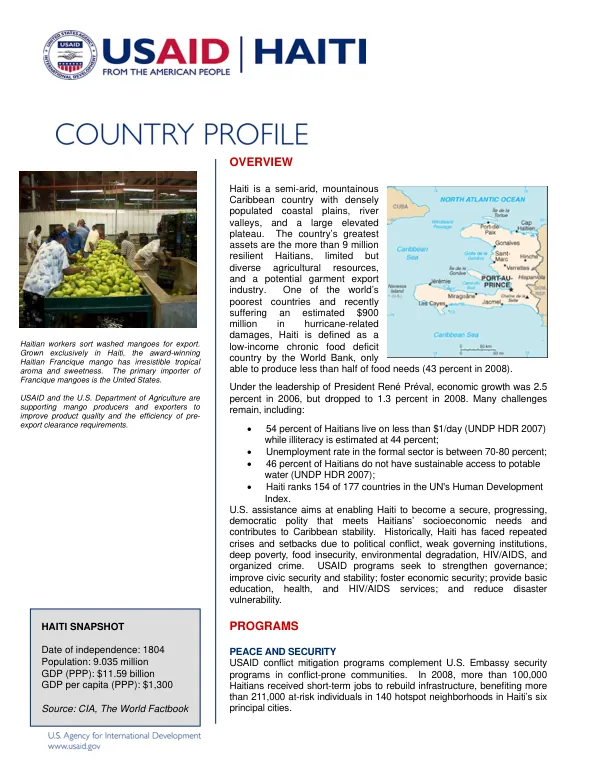
Haiti is a semi-arid, mountainous Caribbean country with densely populated coastal plains, river valleys, and a large elevated plateau.
2010 · 2 pages
Sign in to readA free account is required to download.
Abstract
The country's greatest assets are its resilient population of over 9 million Haitians, limited but diverse agricultural resources, and a potential garment export industry. Haiti is one of the world's poorest countries, having suffered an estimated $900 million in hurricane-related damages. The country is defined as a low-income chronic food deficit country by the World Bank, producing less than half of its food needs, with only 43 percent of food requirements met in 2008. The Haitian economy has faced numerous challenges, including a high unemployment rate of 70-80 percent in the formal sector, with 54 percent of the population living on less than $1 per day. Illiteracy is estimated at 44 percent, and 46 percent of Haitians do not have sustainable access to potable water. The country ranks 154 out of 177 countries in the UN's Human Development Index. USAID assistance aims to enable Haiti to become a secure, progressing, democratic polity that meets Haitians' socioeconomic needs and contributes to Caribbean stability. USAID programs in Haiti focus on strengthening governance, improving civic security and stability, fostering economic security, providing basic education, health, and HIV/AIDS services, and reducing disaster vulnerability. Conflict mitigation programs complement U.S. Embassy security programs in conflict-prone communities. In 2008, more than 100,000 Haitians received short-term jobs to rebuild infrastructure, benefiting over 211,000 at-risk individuals in 140 hotspot neighborhoods in Haiti's six principal cities. USAID assistance has realized progress toward justice reform, legislative branch performance, and civic engagement. Support facilitated the passage of two laws creating a modern Magistrates' School and setting standards for an independent judiciary. Over 9,430 citizens received legal aid or access to Justices of the Peace. USAID programs also strongly support Haiti's social development, financing access to basic health services for approximately 4.8 million Haitians, nearly 50 percent of the population. Services included vaccinations for over 60,000 children and delivery of reproductive health services to more than 200,000 Haitians. USAID programs improve economic opportunities and livelihoods for hundreds of thousands of Haitians. Lending to rural and semi-rural micro-businesses reached over 370,000 clients, particularly women, who utilized 65 percent of the USAID-supported $63.7 million lending portfolio. USAID's Development Credit Authority guarantee program has promoted nearly $2 million of private financing and created an additional $6 million guarantee facility for the productive sectors, raising the overall potential leveraged amount of private financing to $12.5 million. USAID's workforce development program expanded to reach over 4,800 unemployed youth in 2008. In response to increasing food insecurity and hurricanes, USAID's emergency assistance rapidly expanded to provide emergency food assistance to over 2 million Haitians.