ABT ASSOCIATES
Sources of Family Planning: Haiti
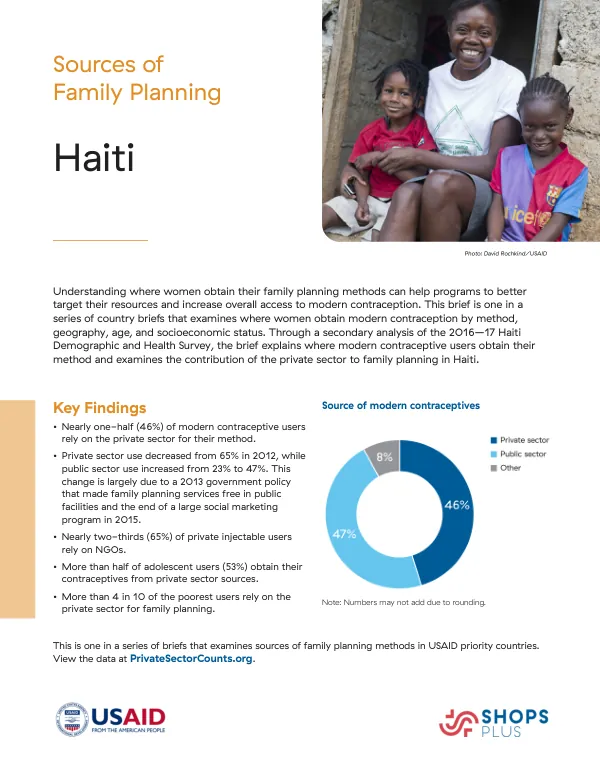
In Haiti, nearly one-half (46%) of modern contraceptive users rely on the private sector for their method.
2019 · 4 pages
Sign in to readA free account is required to download.
Abstract
This reliance on the private sector has decreased from 65% in 2012, while public sector use has increased from 23% to 47%. The change is largely due to a 2013 government policy that made family planning services free in public facilities and the end of a large social marketing program in 2015. Among private sector users in Haiti, 44% rely on a nongovernmental organization, 39% on a pharmacy or shop, and 17% on a hospital or clinic. Use of private hospitals and clinics declined from 30% in 2012, while use of pharmacies and shops increased from 28%. Most private sector injectable users go to an NGO, while private sector condom users typically go to pharmacies or shops. The modern contraceptive prevalence rate in Haiti is 22 percent among all women of reproductive age. The rate is 31 percent among married women. Short-acting methods, particularly injectables and condoms, are much more popular than long-acting reversible contraceptives and permanent methods. Modern contraceptive users in Haiti rely on the public and private sectors in nearly equal proportions, with 47 percent and 46 percent, respectively.
Connected topics
Related documents