USAID DEC
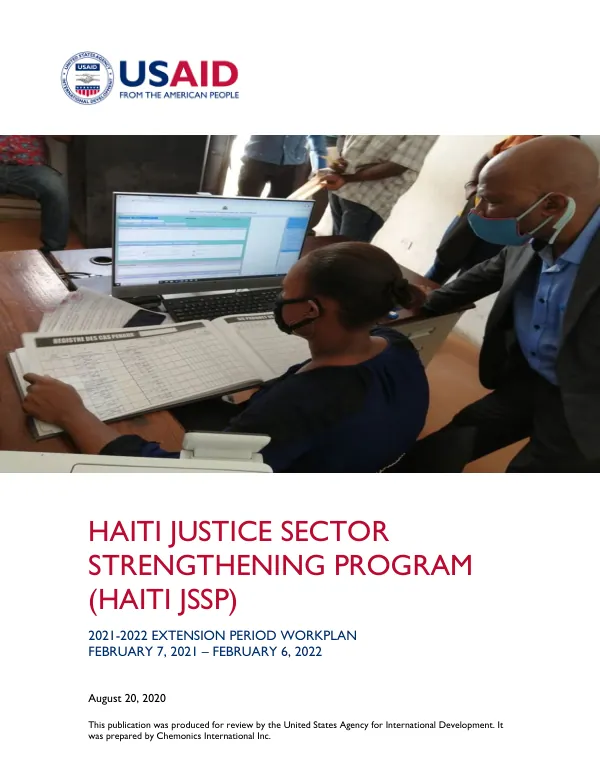
Haiti Justice Sector Strengthening Program (Haiti JSSP) 2021-2022 Extension Period Workplan
Sign inCHEMONICS
Haiti Justice Sector Strengthening Program (Haiti JSSP) 2021-2022 Extension Period Workplan
The USAID Haiti Justice Sector Strengthening Program (JSSP) has been instrumental in achieving significant milestones in the Haitian legal realm since its inception in September 2016.
2021 · 32 pages
Sign in to readA free account is required to download.
Abstract
Key accomplishments include the drafting and adoption of the new penal code and penal procedural code, the drafting and adoption of the historic legal assistance legislation, and the formation of the National Legal Assistance Commission (CNAL) to provide free assistance to those in need. Additionally, the implementation of the Case Management Information System (CMIS) in 11 jurisdictions has improved case management and combated prolonged pretrial detention. Despite significant progress, continued civil unrest, political instability, and the COVID-19 pandemic have hindered the development and implementation of these reforms. The 12-month extension granted by USAID to JSSP is critical in completing and anchoring these reforms. JSSP will provide significant support during the transition period, including holding additional public hearings to ensure consensus on the codes, supporting the transition commission, and developing communication and budget plans. JSSP will also strengthen the capacity of training institutions, including the School of Magistrates (EMA), the Federation of Bar Associations of Haiti (FBH), and law schools, while supporting their strategic plan and training programs. These trainings will focus primarily on the codes, but will also cover topics such as trafficking in Persons (TIP), financial crimes, and sexual gender-based violence (SGBV). Concurrently, JSSP will continue to support implementation of recommendations stemming from findings of the Y4 study on the state of legal education, including introducing a national bar exam and an accreditation process for law schools. The Program will also continue to support the implementation of the law on legal assistance, through strategies that include completing the establishment of the National Committee on Legal Assistance (CNAL). The CNAL may finally lead to a state-owned legal assistance program, after twenty years of complete dependence on donor funding in the country. During the interim period before the introduction of state-funded legal assistance offices as required under the law, JSSP will continue to assist the Legal Aid Offices (BALs) in two jurisdictions - Port-au-Prince and Cap-Haitien. These jurisdictions hold 41% of the total prison population of the country. JSSP will maintain support of various efforts, including the establishment of the quota system in prosecutor offices, to combat pretrial detention and prison overcrowding. In Y1, JSSP analyzed informal and formal justice needs and popular judicial mechanisms in rural and underserved areas. The analysis revealed that citizens do not trust the judiciary, and only 10% of this demographic use the formal justice system for conflict resolution. JSSP followed the study with a series of activities to improve citizen trust in the judiciary, including collaboration with a network of civil society organizations (CSOs). The Case Management Information System (CMIS), operational in 11 jurisdictions, is a significant success in the sector. It allows for the combat of prolonged pretrial detention by providing data on case processing time and case load of judges and prosecutors. The CSPJ will introduce a budget line item to ensure that the system remains operational at the end of the JSSP program.