UNITED NATIONS
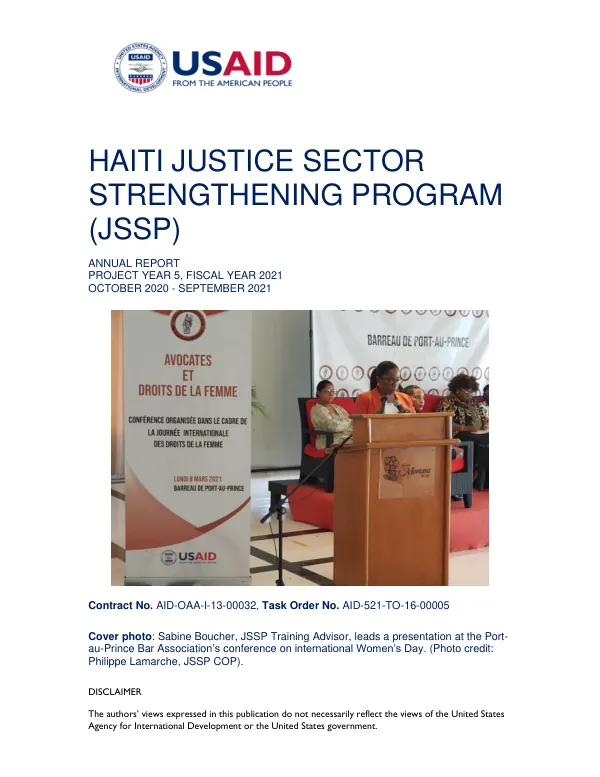
Haiti Justice Sector Strengthening Program (JSSP) Annual Report, Project Year 5
The Justice Sector Strengthening Program (JSSP) in Haiti is a five-year initiative aimed at enhancing the country's justice sector.
2021 · 48 pages
Sign in to readA free account is required to download.
Abstract
The program, which began in 2016, is funded by the United States Agency for International Development (USAID) and is implemented by a consortium of organizations. The primary objective of JSSP is to strengthen the capacity of the Haitian justice sector to provide effective and efficient justice services to the population. In Year 5 (Y5), the program faced significant challenges due to the acute political crisis, rise of gang violence, and COVID-19 pandemic. Despite these challenges, JSSP managed to conduct most of its planned activities by adopting mitigation strategies and being proactive in resolving sector deadlocks. The program operated with reduced funding in Y5, as it conducts its close-out phase with limited staff. JSSP's activities in Y5 included drafting seven executive orders necessary for the penal code and enforcement of the penal procedural code. The program also expanded the Case Management Information System (CMIS) into two new jurisdictions, Les Cayes and Port-de-Paix. The CMIS is a critical tool for tracking and managing cases in the Haitian justice sector. In Y5, 5,324 cases were entered into the system, bringing the total number of cases entered since the program's launch to 46,794. The program also provided technical, logistical, and material support to the newly established National Committee on Legal Assistance (CNAL). The CNAL is a body that funds and oversees nine legal assistance offices (BALs) around the country. JSSP supported BALs in Port-au-Prince, Cap-Haitian, Fort-Liberté, and Saint Marc, which provided free legal assistance to 588 detainees. The BALs of Fort-Liberté and Saint Marc are now fully state-funded through the CNAL, achieving JSSP's goal of sustainability. JSSP has also provided significant support to the École de la Magistrature (EMA), the primary training institution in the justice sector. The program led a training at the EMA on gender for 26 trainee clerks and supported a joint training for clerks on "Ethics of Clerks and Case Management Technology." Additionally, JSSP held a training on gender, ethics, and socio-legal approach for 24 Impact Youth personnel. The program also completed an assessment of lawyers in Haiti to identify issues and recommendations related to the practice of law. The assessment's recommendations included developing a code of ethics for lawyers, as the public largely views them as corrupt. JSSP trained 308 sector operators in Y5, bringing the total number of trained fonctionnaires to 1,897 since the program's launch. Overall, JSSP's efforts in Y5 have contributed to the strengthening of the Haitian justice sector, despite the significant challenges faced by the country. The program's activities have improved the capacity of the justice sector to provide effective and efficient justice services to the population.