USAID DEC
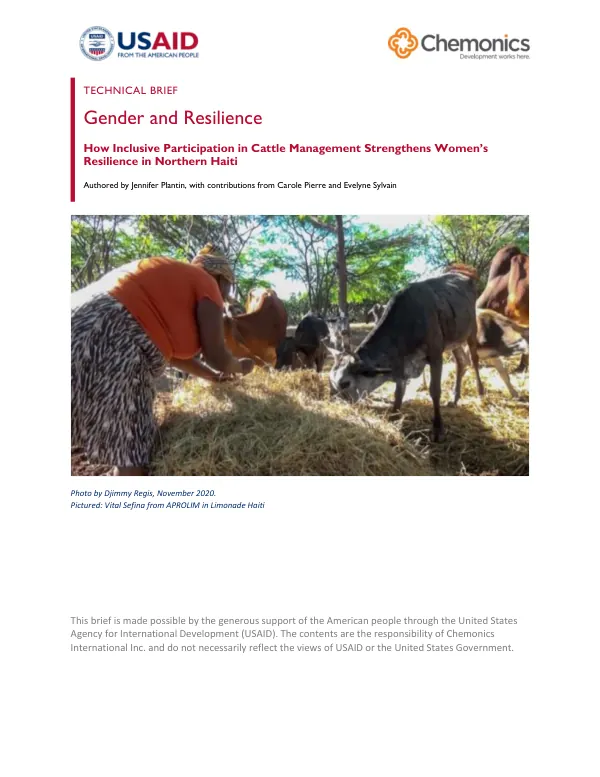
Technical Brief: Gender and Resilience - How Inclusive Participation in Cattle Management Strengthens Women’s Resilience in Northern Haiti
Sign inCHEMONICS
Technical Brief: Gender and Resilience - How Inclusive Participation in Cattle Management Strengthens Women’s Resilience in Northern Haiti
Women in Haiti play a crucial role in the economy and food system, with 62% of Haitian women participating in the labor force, one of the higher percentages in the world.
2021 · 12 pages
Sign in to readA free account is required to download.
Abstract
They are involved in various agricultural production stages, including soil preparation, seed planting, seedling maintenance, harvest, post-harvest activities, and livestock management. However, their role in agriculture is often relegated to oversight of lower-earning crops and production for household consumption. Women tend to participate largely in local and small-scale transactions, with men often playing a supporting role, providing labor and assets such as land in mixed-headed households. The United Nations Development Programme (UNDP) Gender Inequality Index report for 2020 indicates that 63.6% of the loss in Haiti's potential human development is due to gender inequality. Women in Haiti face numerous constraints, including lower income and financial services, higher maternal mortality ratio, and lower literacy rate compared to men. They also have limited access to financial markets, with 58% of the population having recourse to credit, primarily from family, friends, and self-managed solidarity groups. The USAID Reforestation Project in the Nord and Nord-Est Départements of Haiti has emphasized the inclusion of women in program design for livestock management. The project utilized a participatory approach to conduct surveys and focus groups, which showed how local livestock management poses a threat to deforestation and reforestation. The data collected also revealed the opportunity for inclusive cattle management to build household resilience to climate change and economic shock. Inclusive livestock management has been observed to increase household resilience to natural and economic shocks when activity designs apply a gender lens. The project's findings suggest that women's participation in livestock management can strengthen household resilience. Women's resourcefulness and fortitude in surviving despite the numerous challenges they face are commonly referred to as "resilience." The USAID formally defines "resilience" as the ability of people, households, communities, countries, and systems to mitigate, adapt to, and recover from shocks and stresses in a manner that reduces chronic vulnerability and facilitates inclusive growth. The USAID Reforestation Project's strategy for targeted interventions has utilized a participatory approach to conduct surveys and focus groups, which showed how local livestock management poses a threat to deforestation and reforestation. The data collected also revealed the opportunity for inclusive cattle management to build household resilience to climate change and economic shock. The project's results have implications for future resilience activities for the USAID Reforestation Project and future resilience programs in Haiti. The project's emphasis on inclusive livestock management and women's participation in program design has shown promising results for increasing household resilience to natural and economic shocks.