DAI GLOBAL, LLC
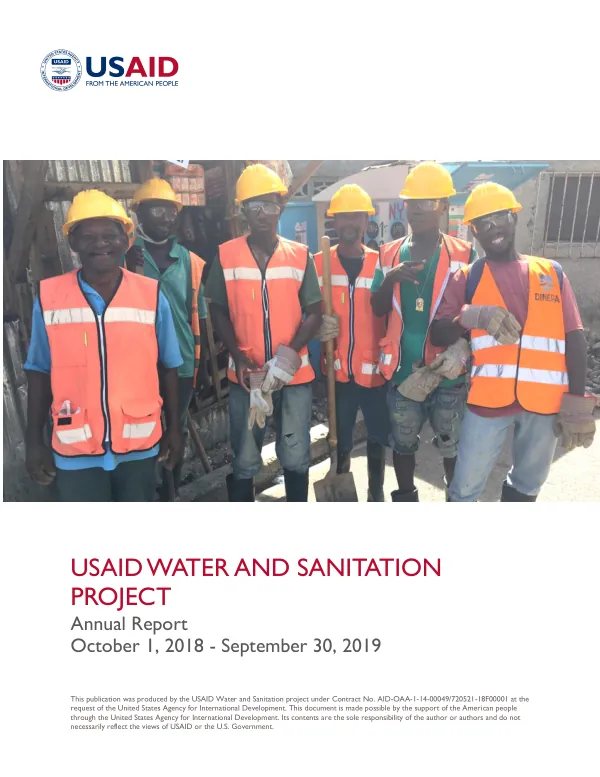
Annual Report: USAID Water and Sanitation Project in Haiti
The USAID Water and Sanitation Project is a $41.8-million, 4.5-year activity implemented in collaboration with Haiti's National Directorate of Potable Water and Sanitation (DINEPA) with the overall goal of improving sanitation and water for all Haitians.
2019 · 31 pages
Sign in to readA free account is required to download.
Abstract
The Project is focused on five geographic areas: three areas hard hit by the 2010 cholera outbreak (Cap-Haïtien, Mirebalais, and Canaan) and two areas hard hit in 2016 by Hurricane Mathew (Les Cayes and Jérémie). This annual report covers the second fiscal year of the Project: 1 October 2018 to 30 September 2019. The Project's three primary goals are: helping 250,000 people get to basic or improved access to water, helping 75,000 people get access to basic or improved sanitation, and laying the foundation for sustainable increases in access to water and sanitation across Haiti. The Project is reaching these goals by focusing on its core values such as self-reliance, resilience, and the private-sector approach. To achieve this vision, the Project established field offices in each of the target areas and assigned one of its senior staff to serve as the advisor in each of DINEPA's regions. In the water sector, the Project is using the World Bank's Water Utility Turnaround Framework: A Guide for Improving Performance (2018) to guide the technical assistance across five dimensions: organization and strategy, human resource management, financial management, technical operations, and commercial operations. The main achievements during FY19 were the development of a detailed snapshot of each of the local water utilities (Centre Technique d'Exploitation, or CTEs) across all five of these dimensions, provision of technical assistance and support to the Les Cayes and Jeremie CTEs, development of annual plans for all four CTEs, and completion of the design for the first three construction activities. In the sanitation sector, the project has been working with municipal authorities in each of the five areas to promote basic sanitation and help small entrepreneurs to better market basic sanitation products. By the end of Year Two, the project will have supported the construction of the first 50 toilets. By the end of Year Three, this figure should rise to 600. The project is also working with DINEPA to reopen the Morne-à-Cabrit fecal sludge management site and develop a realistic business plan to allow it to operate on a cost-recovery basis. The Project is building the capacity of local water utilities (Centre Technique d'Exploitation, or CTE) to help them break free from a vicious cycle of poor service leading to loss of customers, lower revenues, and less frequent service. The project is helping them improve their management strategy, reduce non-revenue water losses, and attract new customers. The situation for the sanitation sector is even worse, with the project working to promote basic sanitation and help small entrepreneurs to better market basic sanitation products. The Project's field offices are established in each of the target areas, with one of its senior staff serving as the advisor in each of DINEPA's regions. The central office has been moved from Cap Haïtien to Port-au-Prince to improve coordination with DINEPA, USAID, and other actors. The Project is using the World Bank's Water Utility Turnaround Framework to guide technical assistance in the water sector, focusing on five dimensions: organization and strategy, human resource management, financial management, technical operations, and commercial operations.