USAID DEC
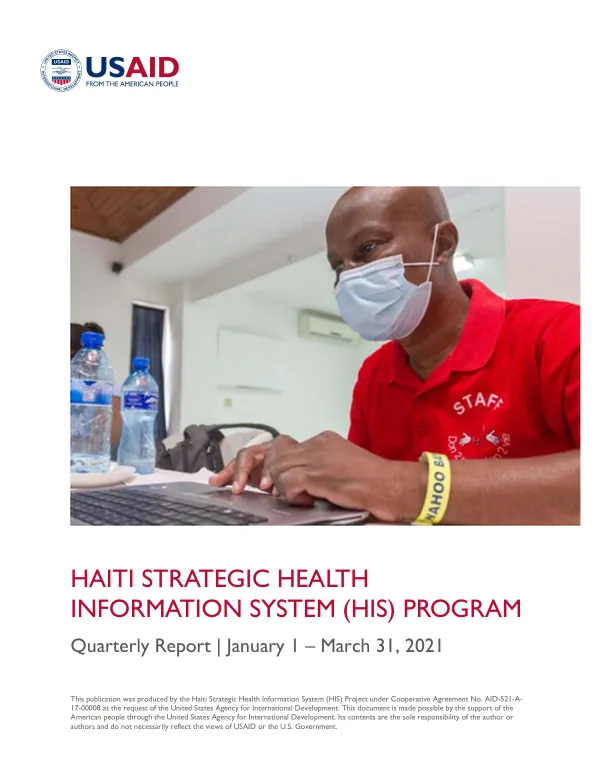
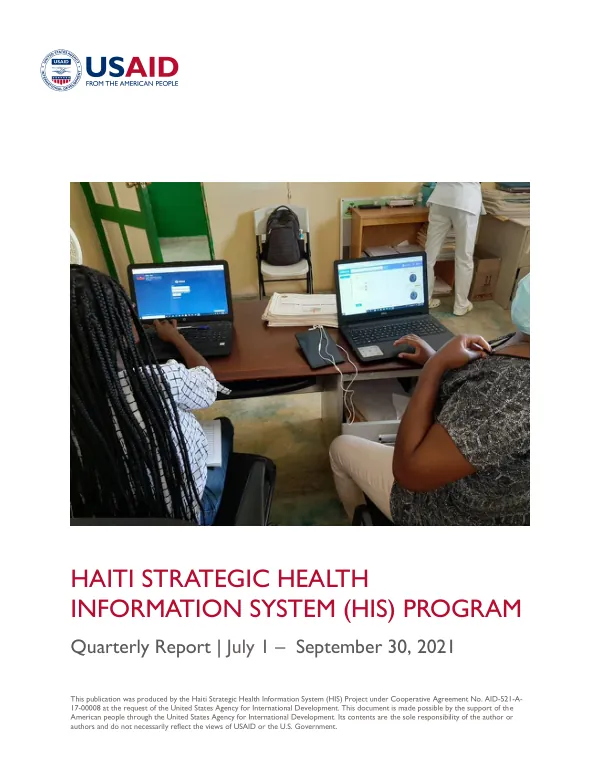
Haiti Strategic Health Information System (HIS) Program Quarterly Report July 1 – September 30, 2018
Sign inDAI
Haiti Strategic Health Information System (HIS) Program Quarterly Report July 1 – September 30, 2018
The Haiti Strategic Health Information System (HIS) Program supports the Haitian Ministère de la Santé Publique et de la Population (MSPP) to increase timely access to and use of information for informed public health assessments and policy decision-making, thereby improving Haitian health service delivery.
2018 · 12 pages
Sign in to readA free account is required to download.
Abstract
The program's two key objectives include building the capacity of the Ministry of Health to effectively implement, manage, oversee, and maintain a comprehensive, cross-sector health management information system and developing an e-health policy based on principles of host-country ownership, and responsible use and protection of information. The HIS Program is providing ongoing technical assistance to the MSPP to strengthen their central HIS system Système d'Information Sanitaire Nationale Unique (SISNU). The program is addressing various gaps in data collection, integration, and usability, as well as supporting the drafting of eHealth policy and associated interoperability and data standard guidelines. Furthermore, the program promotes a culture of data demand and use. During the reporting quarter July – September 2018, the HIS Program conducted several activities. The national roll-out of SISNU was fully operational and functional throughout all ten departments, including specific sites that enter data directly. Seven new sites are currently using SISNU to publish their monthly reports. The HIS team initiated a revision to the norms and protocol for data entry and reporting in SISNU, emphasizing data production, data dissemination, data demand, and information use while highlighting the roles and responsibilities of everyone involved in the process. Data for this study were collected among health facilities in three departments (South, Southeast, and North) from July 7-24. The vast majority of healthcare providers (88%) stated that they received clear instructions on how to fill out data collection and reporting tools, including paper and electronic registers and monthly report forms. The fiscal year 2017 was used as the reference year to evaluate completeness of data, and it was found that none of the selected health facilities has filled 90% or more of the required fields in any register. The HIS team provided substantial technical support in developing the design and writing the 2017 statistical report. The final version was approved by the Minister of Health, and the dissemination of the report is pending final review and concurrence by the Minister. The team also provided technical support on the final revision, mock presentation, and dissemination of the latest DHIS survey. The program has also made progress in designing and implementing a digital health platform. The TB Tracker system was improved to incorporate valuable analytics such as dashboard indicators created by PNLT. The number of patients being tracked and monitored by the system at the end of this quarter grew from 10,294 to 16,345, an increase of 58.8% from last quarter. The Community Health Information System (CHIS) tracker was also developed, and UEP informed the project of its decision to move forward with the development of a CHIS tracker.
Related documents