USAID DEC
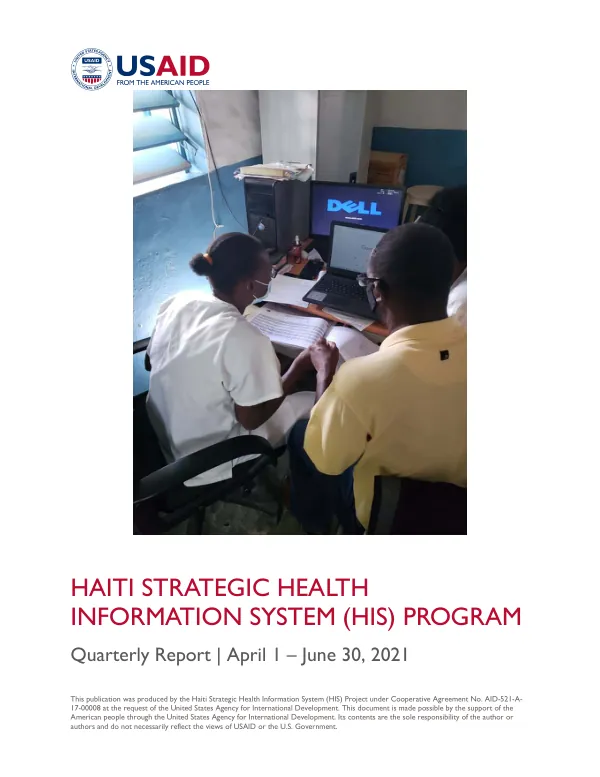
Haiti Strategic Health Information Systems (HIS) Program Quarterly Report | April 1, 2021 – June 30, 2021
Sign inDAI GLOBAL, LLC
Haiti Strategic Health Information Systems (HIS) Program Quarterly Report | April 1, 2021 – June 30, 2021
The Haiti Strategic Health Information Systems Program (Haiti HIS) is a cooperative agreement funded by the United States Agency for International Development (USAID) to build the capacity of Haiti's Ministère de la Santé Publique et de la Population (MSPP) to take ownership of Haiti's comprehensive health information system, Le Système d'Information Sanitaire National Unique (SISNU).
2021 · 19 pages
Sign in to readA free account is required to download.
Abstract
SISNU aims to integrate Haiti's health records across various digital and paper-based reporting platforms into a single system. The program supports MSPP under three focus areas: (a) strengthening SISNU by addressing information and technical gaps, (b) improving the quality of data, and (c) promoting better system governance and stewardship. This support contributes to the following two project objectives: Objective 1: Build the capacity of the Ministry of Health (MOH) to effectively implement, manage, oversee, and maintain a comprehensive, cross-sector health management information system, and Objective 2: Develop an e-health policy based on principles of host-country ownership, responsible use, and protection of information. During Fiscal Year (FY) 2021 Quarter Three (Q3), the Haiti HIS project made substantial progress toward project objectives with continuous delivery excellence. The project continued to work with the Unité d'Etudes et de Programmation (UEP) on the next steps in the development of a Haitian national digital health policy. The District Health Information Software (DHIS2) deployment method was improved, and the use of project resources was optimized in terms of server hosting cost and utilization. The integration effort of the Rapport mensuel de gestion logistique des intrants essentiels et stratégiques de santé (SIGL) continued to track data on essential drugs and laboratory inputs, including their purchasing, storage, and distribution, with a Smart Paper Technology (SPT) component to capture paper-based data that cannot be inputted electronically. The number of reported tuberculosis (TB) cases on the TB tracker rose from 7,356 cases at the beginning of 2018 to 58,548 by the end of FY 2021 Q3. The project's goal is to build the capacity of MSPP to take ownership of Haiti's comprehensive health information system: SISNU. The project supports the MSPP to strengthen SISNU by integrating health records across digital and paper-based reporting platforms, addressing information and technical gaps, improving data quality, and promoting better system governance and stewardship. Through these continuous improvements, SISNU will provide the information needed by MSPP for better public health decision-making, helping the Government of Haiti to provide higher quality health care and treatment to the Haitian people. The project's activities and key achievements across the program's objectives and results are summarized in this report. The project's technical team and UEP continue to optimize the use of project resources both in terms of server hosting cost and utilization. The project continues to work closely with Solution S.A., the IT company managing Monitoring, Evaluation, and Surveillance Intégrée (MESI), to automatically integrate HIV data from MESI to SISNU. The project also continues to work closely with a European non-profit organization, Shifo Foundation, to operationalize the integration between the SIGL system and DHIS2 operational. The SIGL monthly report is used for data reporting on essential drugs and laboratory inputs. The project's progress toward project objectives in FY 2021 Q3 is a significant step toward achieving the project's overall goal of building the capacity of MSPP to take ownership of Haiti's comprehensive health information system: SISNU.
Related documents