USAID DEC
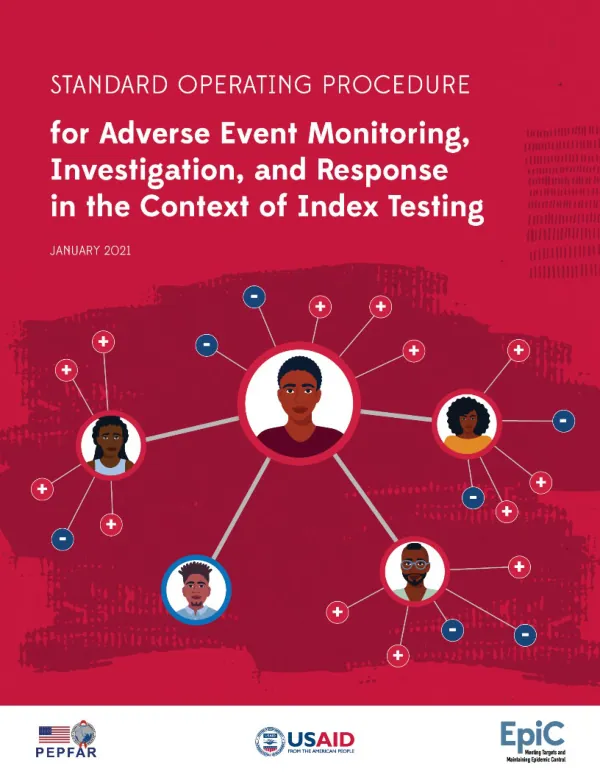
Standard Operating Procedure for Adverse Event Monitoring, Investigation, and Response in the Context of Index Testing
Sign inFHI 360
Standard Operating Procedure for Adverse Event Monitoring, Investigation, and Response in the Context of Index Testing
Adverse Event Monitoring, Investigation, and Response in the Context of Index Testing is a standard operating procedure (SOP) intended to help facility managers and healthcare workers involved in index testing to prevent adverse events, encourage clients to report adverse events, and support providers to respond to and document adverse events.
2021 · 35 pages
Sign in to readA free account is required to download.
Abstract
This SOP is designed to meet the requirements of the President's Emergency Plan for AIDS Relief (PEPFAR) and adhere to the 5 Cs (consent, confidentiality, counseling, correct test results, and connection to prevention/treatment). The SOP defines an adverse event as an incident that results in harm to the client or others as a result of their participation in index testing services or because they were offered index testing services and declined to accept them. Harm includes any intended or unintended physical, economic, emotional, or psychosocial injury or hurt caused by one person to another, a person to themselves, or an institution to a person, occurring before, during, or after index testing services. The SOP categorizes adverse events into severe and serious categories. Severe adverse events include threats of physical, sexual, or emotional harm, occurrences of physical, sexual, or emotional harm, threats or occurrences of economic harm, withholding HIV treatment or other services, forced or unauthorized disclosure of client's or contact's name or personal information, and abandonment or forced removal of children under 19 years old from the home. Serious adverse events include contacting partners without obtaining consent, stigma perpetrated by health site staff, and criminalization. The SOP outlines procedures for ensuring a safe and ethical environment for index testing, including training staff on adherence to the 5 Cs, conducting IPV risk assessments, and providing first-line support if violence is disclosed. The SOP also requires staff to document and monitor consent, IPV, and frequency of adverse events, and to flag sites with unusually high acceptance of index testing services for supportive supervision monitoring visits. The SOP emphasizes the importance of actively monitoring reasons for clients' refusal of index testing services, prevalence of IPV, and other adverse events, and to investigate each reported adverse event and follow up. The SOP also provides content recommendations for violence response services in Appendix A. The SOP is intended for facility managers and healthcare workers involved in index testing, and is designed to be integrated into a larger SOP covering index testing. The SOP does not need to be a standalone document, but can be incorporated into existing SOPs. The procedures outlined in the SOP are designed to ensure that index testing services are conducted in a safe and ethical manner, and that adverse events are prevented, reported, and responded to in a timely and effective manner. The SOP is intended to meet the requirements of PEPFAR and to adhere to the 5 Cs, and is designed to promote the health and well-being of clients receiving index testing services. The SOP requires all staff who manage index testing services or who are involved in conducting index testing to understand and follow the procedures outlined in the SOP. The SOP also requires program staff to be trained on the procedures and to provide day-to-day oversight and support of relevant staff. The SOP has ultimate responsibility for ensuring that all applicable staff members follow the procedures outlined in the SOP. The SOP provides a framework for ensuring that index testing services are conducted in a safe and ethical manner, and that adverse events are prevented, reported, and responded to in a timely and effective manner. The SOP is an important tool for promoting the health and well-being of clients receiving index testing services, and for meeting the requirements of PEPFAR. The SOP requires staff to be trained on the procedures outlined in the SOP, including adherence to the 5 Cs, conducting IPV risk assessments, and providing first-line support if violence is disclosed. The SOP also requires staff to document and monitor consent, IPV, and frequency of adverse events, and to flag sites with unusually high acceptance of index testing services for supportive supervision monitoring visits. The SOP is designed to be integrated into a larger SOP covering index testing, and does not need to be a standalone document. The SOP is intended for facility managers and healthcare workers involved in index testing, and is designed to promote the health and well-being of clients receiving index testing services.
Related documents