USAID DEC
Harnessing Behavioral Insights to Strengthen Gender-Based Violence Policy Implementation in Guatemala
Sign inUNITED NATIONS
Harnessing Behavioral Insights to Strengthen Gender-Based Violence Policy Implementation in Guatemala
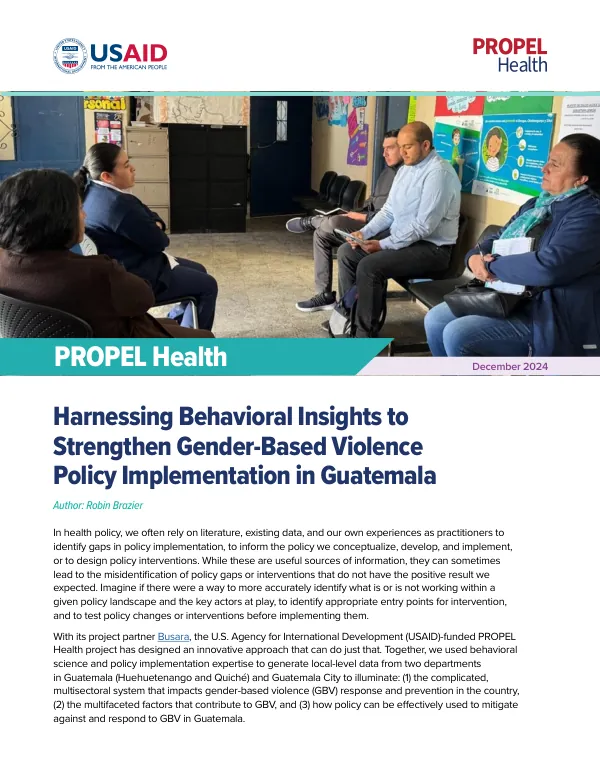
Harnessing Behavioral Insights to Strengthen Gender-Based Violence Policy Implementation in Guatemala is a project aimed at improving the effectiveness of policies addressing gender-based violence (GBV) in the country.
2024 · 8 pages
Sign in to readA free account is required to download.
Abstract
The project, funded by the U.S. Agency for International Development (USAID), was conducted in collaboration with Busara, a partner organization. The project's primary goal was to generate local-level data from two departments in Guatemala (Huehuetenango and Quiché) and Guatemala City to illuminate the complicated, multisectoral system that impacts GBV response and prevention in the country. Gender inequality and GBV remain significant barriers to reproductive health and rights, the uptake of family planning, and achievement of broader development goals such as economic growth. More than one-third of women worldwide report experiencing physical and/or sexual violence. The negative consequences of GBV on women's reproductive health are many, including unintended pregnancies, pregnancy complications, unsafe abortion, increased vulnerability to sexually transmitted infections, and increased adolescent pregnancy. Beyond health implications, GBV has substantial economic consequences, including lost earnings and necessary expenditures to respond to GBV. In Guatemala, GBV has a particularly painful history, having been used as a tool of war during the 36-year civil conflict that ended in 1996. This legacy persists due to enduring machismo attitudes and socio-economic challenges that limit women's access to education and health services, increasing their vulnerability to violence. Even though the country has various policies in place that together make up the potential for a strong framework for preventing and responding to GBV, the problem persists. The Public Ministry of Guatemala reported 51,906 claims of violence against women in 2018, making violence against women the most reported crime in the country. To respond to the pressing challenge of successful GBV policy implementation in Guatemala, PROPEL Health and Busara brought together their expertise in policy implementation assessment and systemic behavioral science. The first important milestone in this approach was to create a system map. To launch this process, PROPEL Health conducted an extensive desk review to understand the gender context and GBV policy landscape in Guatemala. In addition, PROPEL Health and Busara integrated complementary elements of the policy implementation assessment tool into Busara's behavioral assessment instruments, adding a policy element to their data collection tools. The project conducted three phases of data collection, including stakeholder workshops, individual interviews, and focus group discussions and health care site visits. The analysis focused on policy implementation at the three levels of care in Guatemala, including the first level of care, which represents the foundational level of health provision, primarily located in smaller, rural communities; the second level of care, which includes health centers and permanent care centers that provide a broader range of services and have emergency capabilities; and the third level of care, which consists of mostly hospitals that are equipped for specialized care, including in some cases, dedicated sexual violence clinics. Learnings from the systems mapping and behavioral assessments allowed for the completion of a computational systems model that simulated changes in the system in order to identify leverage points and future interventions for improved GBV policy implementation. This model can be used to test policy changes or interventions before implementing them, allowing for more accurate identification of what is or is not working within a given policy landscape and the key actors at play.