USAID DEC
Mobile Outreach Health Service for Women in Rural Guatemala: Overcoming Voluntary Family Planning Barriers
Sign inWORLD HEALTH ORGANIZATION
Mobile Outreach Health Service for Women in Rural Guatemala: Overcoming Voluntary Family Planning Barriers
The Mobile Outreach Health Service for Women in Rural Guatemala is a program designed to overcome voluntary family planning barriers faced by indigenous Maya women.
2021 · 4 pages
Sign in to readA free account is required to download.
Abstract
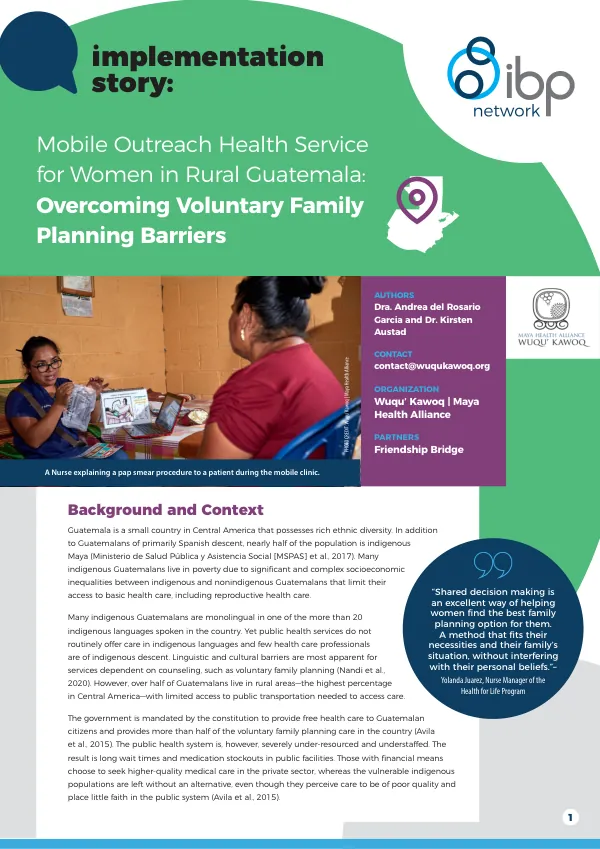
The program, implemented by Wuqu' Kawoq | Maya Health Alliance in partnership with Friendship Bridge, aims to provide preventive health services, including voluntary contraception counseling and immediate provision of contraceptive methods, to women in their homes. The program's success is attributed to its novel mobile outreach service delivery approach, which brings care closer to women in rural areas. Nurses, who are fluent in Mayan languages and paid a monthly salary, offer in-home contraception counseling and immediate provision of a wide variety of contraceptive methods. The knowledge of the language paired with a shared decision-making approach to voluntary family planning counseling reinforces women's autonomy in making their own reproductive health choices. Rigorous nurse training has been vital to the program's success. Nurses receive extensive training in communication techniques to help each woman clarify her reproductive goals, elicit her unique preferences, and guide her to a "best fit" method. The training consists of a three-day classroom training that includes role-playing and values clarification exercises. The impact of the program is evident in its programmatic data, which shows a higher rate of long-acting reversible contraception (LARC) use compared to national averages. Qualitative interviews with clients suggest that trust in the provider and assurance that LARCs will be removed if patients are unsatisfied are important reasons for this trend. Patients value the one-on-one counseling provided by nurses and follow-up to ensure they are happy with their chosen method. The program's protocols dictate a six-week follow-up call or visit, followed by a six-month follow-up, and a yearly visit thereafter. In most cases, a phone call will suffice, but in-person follow-up is preferred for LARCs in order to look for proper placement and signs of infection. Providing care in rural areas comes with a number of challenges, including locating patients' homes without formal addresses. To address this, the program supports nurses with technology that enables them to locate patients' homes and document their visits in a cellphone-based electronic medical record system. The program has served over 9,000 patients since its inception in 2015 and has expanded to five of Guatemala's geographic departments. The partnership with Friendship Bridge enables the program to reach their clients and provide preventive health care exclusively to them. By doing so, Friendship Bridge provides connections to an existing network of rural underserved women, the population with the highest unmet need for contraception in Guatemala. The program's success is also attributed to its ability to recruit indigenous Maya personnel, who are fluent in the Mayan languages spoken by their clients. This allows for a more culturally sensitive and effective approach to providing reproductive health services to indigenous women. The program's focus on shared decision-making and patient-centered care has resulted in high patient satisfaction and a strong sense of trust between patients and providers. Overall, the Mobile Outreach Health Service for Women in Rural Guatemala is a successful program that has made significant strides in overcoming voluntary family planning barriers faced by indigenous Maya women. Its innovative approach to providing reproductive health services in rural areas has resulted in high patient satisfaction and a significant increase in the use of long-acting reversible contraception.