USAID DEC
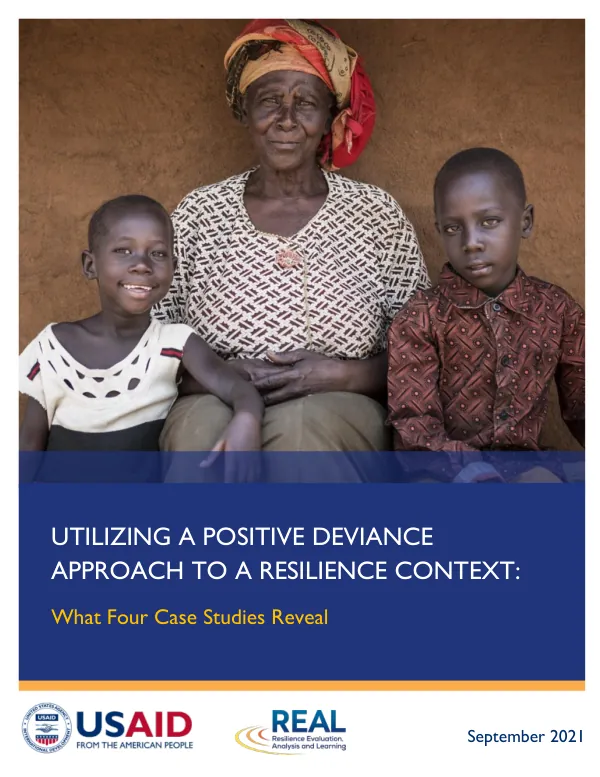
Utilizing a Positive Deviance Approach to a Resilience Context: What Four Case Studies Reveal
Sign inFOOD FOR THE HUNGRY, INTERNATIONAL
Utilizing a Positive Deviance Approach to a Resilience Context: What Four Case Studies Reveal
The positive deviance approach is an assets-based method for social and behavior change that identifies solutions to community problems within the community.
2021 · 21 pages
Sign in to readA free account is required to download.
Abstract
Pioneered in the early 1990s as a means of improving child nutrition, positive deviance is defined as the identification of individuals or families whose practices and behaviors enable them to find better solutions to problems than their neighbors who have access to the same resources. In a programming context, traditional design approaches begin with "outside" expert-driven analyses of the problem(s). However, the positive deviance approach diverges from the traditional process by focusing instead on the "community capacity side" of the assessment, and in particular, what positive deviance behaviors confer uncommon outcomes for certain individuals and the assets underlying those behaviors. The positive deviance approach is most effectively used when addressing intractable problems that require behavior change as part of the solution and where there is evidence that some individuals or households have effectively responded to a common problem, even when they are not appreciably different from their neighbors in terms of socioeconomic status, educational attainment, or other characteristics. Four case studies have been conducted to examine the application of the positive deviance approach in programs aimed at strengthening household and community resilience. These studies have sought to understand why some people do better than others in the same situation, with the same set of conditions and resources. The studies have identified specific behaviors practiced by adopters that are lacking in others and have the potential for wider dissemination. The positive deviance approach has been employed in a wide range of contexts, including emergency response in Indonesia, resilience and recovery programming among farmers in Puerto Rico after Hurricane Maria, prevention of child trafficking in Uganda and Indonesia, and improving governance as part of the Ebola response. Researchers have used the PD approach to identify resilience behaviors, though it is still potentially underutilized in resilience initiatives. Both quantitative and qualitative data can be used to identify the positive deviants in a community and the positive deviant behavior(s). Community validation is crucial to discerning which behavioral solutions have the potential for wider dissemination. Relevant PD behaviors should make sense to both community members and development practitioners. The positive deviance approach is not a magic bullet, and not all positive deviance behaviors may be broadly applicable as solutions to a problem or set of problems. However, it has the potential to provide a better understanding of how similarly vulnerable household and communities can most effectively employ their assets and capacities in response to shocks and stresses. The REAL Associate Award, a consortium-led effort funded by the USAID Center for Resilience, has supported the development of the positive deviance approach in the context of resilience programming. The award has provided funding for research and analysis to identify and promote positive deviance behaviors that can improve household and community resilience. The positive deviance approach has the potential to provide a more effective and sustainable approach to resilience programming by focusing on the assets and capacities of communities rather than their deficits. By identifying and promoting positive deviance behaviors, development practitioners can help communities to build their resilience and improve their ability to respond to shocks and stresses.
Related documents