USAID | VIETNAM
Harnessing the Private Sector to Develop a DPPA Pilot Program
Renewable energy procurement is a critical strategy for multinational companies to reduce their operational impacts on the environment.
2021 · 2 pages
Sign in to readA free account is required to download.
Abstract
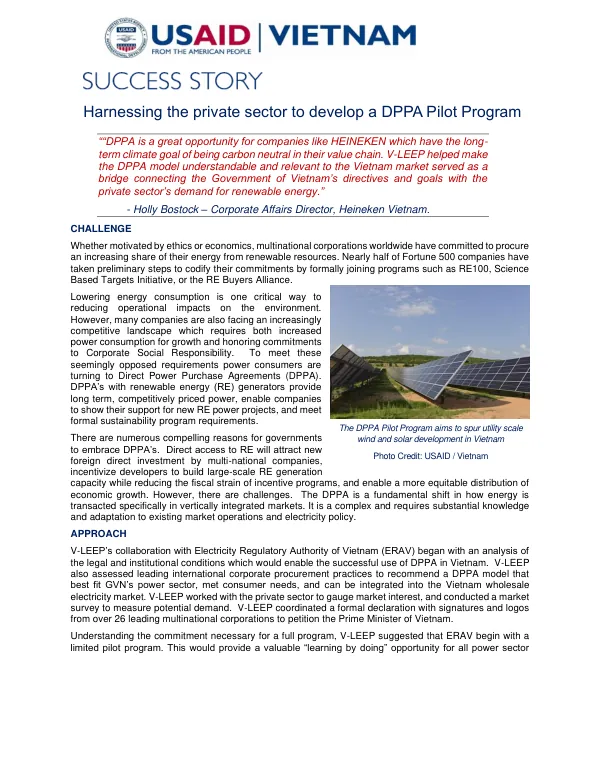
Many companies have committed to procuring an increasing share of their energy from renewable resources, with nearly half of Fortune 500 companies taking preliminary steps to formalize their commitments through programs such as RE100, Science Based Targets Initiative, or the RE Buyers Alliance. Lowering energy consumption is a key way to reduce operational impacts, but companies are also facing increased power consumption and pressure to honor commitments to sustainability. Direct Power Purchase Agreements (DPPAs) offer a solution for companies to meet these competing requirements. DPPAs provide long-term, competitively priced power from renewable energy sources, enabling companies to demonstrate support for new renewable energy projects and meet formal sustainability program requirements. DPPAs also offer several benefits for governments, including attracting new foreign direct investment, incentivizing the development of large-scale renewable energy generation capacity, and reducing the fiscal burden of incentive programs. The Electricity Regulatory Authority of Vietnam (ERAV) and V-LEEP collaborated to develop a DPPA model that would be suitable for Vietnam's power sector, meet consumer needs, and be integrated into the Vietnam wholesale electricity market. V-LEEP conducted a market survey to measure demand and coordinated a formal declaration with over 26 leading multinational corporations to support the Prime Minister of Vietnam. To ensure a successful program, V-LEEP suggested that ERAV begin with a limited pilot program to provide a "learning by doing" opportunity for all power sector stakeholders. The DPPA Pilot Program aims to spur the development of utility-scale wind and solar projects in Vietnam. In June 2019, the Ministry of Industry and Trade (MOIT) and V-LEEP held a DPPA Public Consultation Workshop, where approximately 120 participants learned about the proposed pilot program. The event marked a significant step in the development of the DPPA program, with GVN confirming its commitment to launch the pilot program. Despite the challenges posed by the COVID-19 pandemic, V-LEEP and ERAV continued to work on the program, and ERAV released a draft of its DPPA Circular for public comment in April 2021. The development of the DPPA program has provided several lessons for governments and development programs. Trusted advisors and public-private partnerships can provide effective communication of the private sector's minimum investment and development requirements to governments. Donors can build support for key programs by channeling the influential voice of foreign direct investment and leveraging the positions of relevant stakeholders. A formal, widely publicized declaration of support from multinational corporations can spur government attention and commitment to a program. Pilot programs can provide a useful tool for testing policy interventions, allowing for small-scale opportunities to "learn by doing" and address potential program deficiencies before full-scale implementation.