USAID DEC
Deep-Dive Workshop on the Results of the First Cycle of Implementation Research for UHC in Indonesia: JKN at the Primary Care Level
Sign inABT ASSOCIATES
Deep-Dive Workshop on the Results of the First Cycle of Implementation Research for UHC in Indonesia: JKN at the Primary Care Level
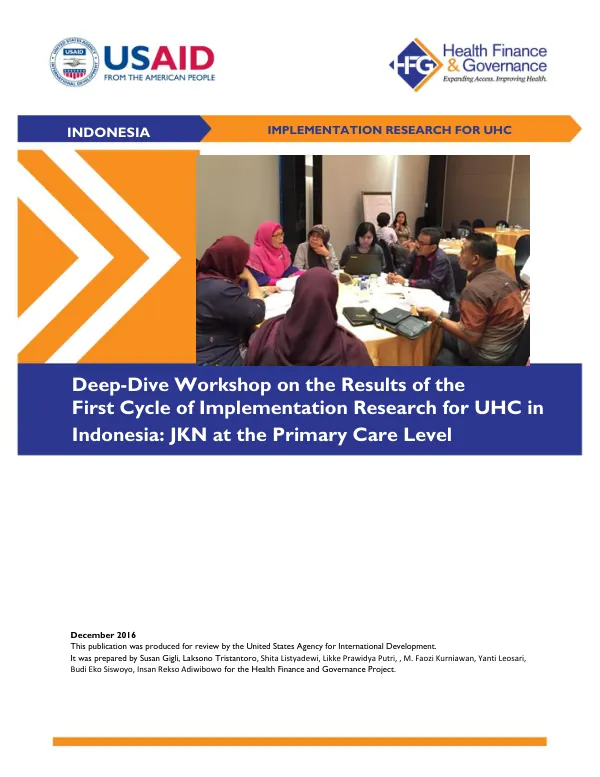
The deep-dive workshop on the results of the first cycle of implementation research for Universal Health Coverage (UHC) in Indonesia was held in Jakarta on 20-21 October 2016.
2016 · 44 pages
Sign in to readA free account is required to download.
Abstract
The workshop aimed to disseminate the results of the implementation research focusing on Jaminan Kesehatan Nasional (JKN) at the primary care level in 5 districts: Jember, Tapanuli Selatan, Jayapura, Jayawijaya, and Jakarta Timur. The objectives of the workshop were to engage stakeholders in discussion of and learning from the findings, produce actionable recommendations for strengthening JKN policy and regulations on primary care, and provide input for the second cycle of IR for UHC. The workshop presentations, plenary sessions, and group discussions focused on the two kinds of gaps explored in the IR: gaps between 'best practice' UHC policy and regulations on primary care and JKN policy and regulations, and gaps between JKN policy and regulations on primary care and their implementation. The policy and implementation gaps were discussed in the context of three key issues highlighted in the research: capitation as currently implemented has little impact on improving performance, the nature of the district health offices' (DHOs') authority to ensure that resources are spent to produce desired health outcomes is ambiguous, and there is a misalignment between Indonesia's policies for decentralized health service provision and the national regulations of BPJS as a financial institution with a centralized structure. There was overall agreement among the national and district stakeholders with the policy and implementation gaps identified in the first cycle of IR. Recommendations to strengthen JKN policy ranged from clarifying specific regulations and improving communication and information sharing between local government and BPJS, to adjusting capitation to local contexts and distributing incentives based on individual performance. Measures to address the most pressing challenges in JKN implementation included mapping health worker recruitment needs, enhancing recruitment efforts, and allowing for greater flexibility in hiring; improving cross-sector collaboration among DHOs, local governments, and BPJS; synchronizing the health information software systems, P-Care and SIMPUS; aligning JKN performance-based payment indicators with local policy on monitoring health facility performance; and increasing outreach services and collaboration with private facilities. The workshop also identified potential topics for IR cycle 2, including capitation, spending on public health prevention/promotion, primary care doctors, and managing health worker recruitment needs. These topics were discussed in the context of their acceptability, feasibility, and appropriateness, and potential benefits and IR domains were identified. Follow-up presentations and consultations are planned with national- and district-level stakeholders to dive deeper into IR cycle 1 findings and to obtain further input into potential topics for IR cycle 2. The implementation research for UHC in Indonesia aims to strengthen JKN policy and regulations on primary care and improve the effectiveness of JKN implementation. The research focuses on identifying gaps between 'best practice' UHC policy and regulations on primary care and JKN policy and regulations, and gaps between JKN policy and regulations on primary care and their implementation. The research also aims to provide actionable recommendations for strengthening JKN policy and regulations on primary care and improving the effectiveness of JKN implementation. The research has identified several key issues that need to be addressed to improve the effectiveness of JKN implementation, including the need to clarify specific regulations and improve communication and information sharing between local government and BPJS, adjusting capitation to local contexts, and distributing incentives based on individual performance. The research has also identified the need to map health worker recruitment needs, enhance recruitment efforts, and allow for greater flexibility in hiring; improve cross-sector collaboration among DHOs, local governments, and BPJS; synchronize the health information software systems, P-Care and SIMPUS; align JKN performance-based payment indicators with local policy on monitoring health facility performance; and increase outreach services and collaboration with private facilities. Overall, the implementation research for UHC in Indonesia aims to improve the effectiveness of JKN implementation and strengthen JKN policy and regulations on primary care. The research has identified several key issues that need to be addressed to achieve this goal, and has provided actionable recommendations for strengthening JKN policy and regulations on primary care and improving the effectiveness of JKN implementation.