AVENIR HEALTH
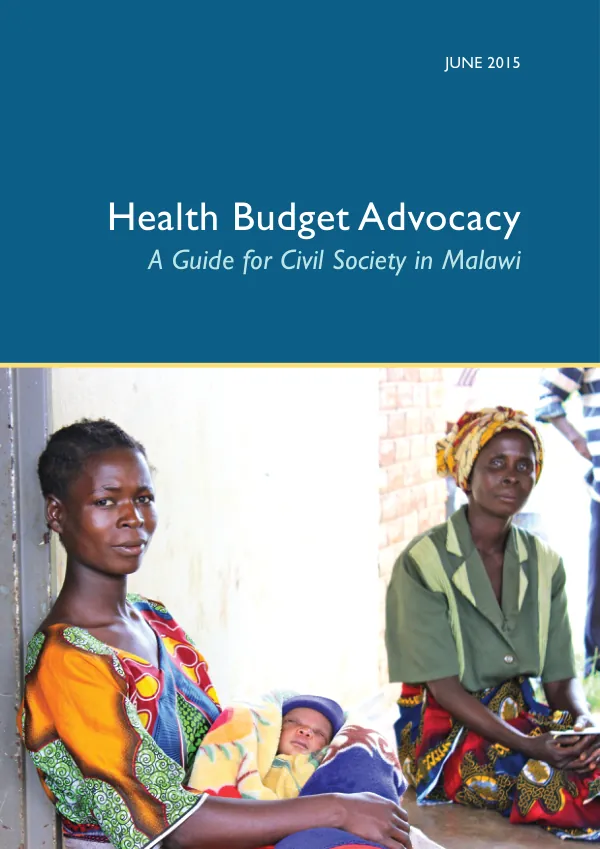
Health Budget Advocacy: A Guide for Civil Society in Malawi
Health systems are essential to achieving health and development goals.
2015 · 67 pages
Sign in to readA free account is required to download.
Abstract
The health system consists of all organisations, people, and actions whose primary intent is to promote, restore, or maintain health. The primary goal of a health system is to improve health—both overall health and health equity—and to do so in ways that are responsive, financially fair, and make the best, or most efficient, use of available resources. Health systems are composed of six "building blocks": (1) service delivery; (2) health workforce; (3) information; (4) medical products, vaccines, and technologies; (5) financing; and (6) leadership/governance. These components interact to impact the health system's overall goals and outcomes. Health financing is an important factor affecting the strength of health systems, and global resources are limited, so it is essential to make the best use of available resources even as we continue to generate additional resources for health. In Malawi, government health budgets are a crucial piece of the health system. The health budget is developed at both the national and district levels. At the national level, the Ministry of Finance, Economic Planning and Development (MoFEPD) is responsible for developing the national budget, which includes the health budget. The Ministry of Health (MOH) plays a key role in the budget development process, providing input on health sector priorities and requirements. The health budget is allocated to various health facilities and programs, including district hospitals, health centers, and community-based programs. The budget is also used to fund health sector initiatives, such as disease control programs and health promotion activities. The allocation of the health budget is guided by the Malawi Growth and Development Strategy (MGDS) and the Health Sector Strategic Plan (HSSP). Civil society organisations (CSOs) play a critical role in influencing government health budgets in Malawi. CSOs can engage with government officials, provide technical input, and advocate for increased funding for health programs and services. CSOs can also monitor government health budgets and track the allocation of funds to ensure that they are used effectively and efficiently. The Health Policy Project, with funding from the United States Agency for International Development (USAID), has developed a guide for civil society organisations in Malawi on health budget advocacy. The guide provides an introduction to health budget advocacy, describes the health budget development process, and suggests entry points for advocates to influence government health budgets. The guide also includes case studies of successful health budget advocacy initiatives in Malawi. The guide highlights the importance of building coalitions and networks with government partners, civil society organisations, and other stakeholders to influence government health budgets. It also emphasizes the need for effective communication and advocacy strategies to engage government officials and other stakeholders. The guide provides practical tools and resources for CSOs to use in their health budget advocacy efforts, including budget analysis and monitoring, stakeholder analysis, and media engagement. In conclusion, health budget advocacy is a critical component of health system strengthening in Malawi. CSOs play a key role in influencing government health budgets, and the guide developed by the Health Policy Project provides a valuable resource for CSOs to use in their advocacy efforts. By working together, CSOs and government partners can ensure that government health budgets are used effectively and efficiently to improve health outcomes in Malawi.