USAID DEC
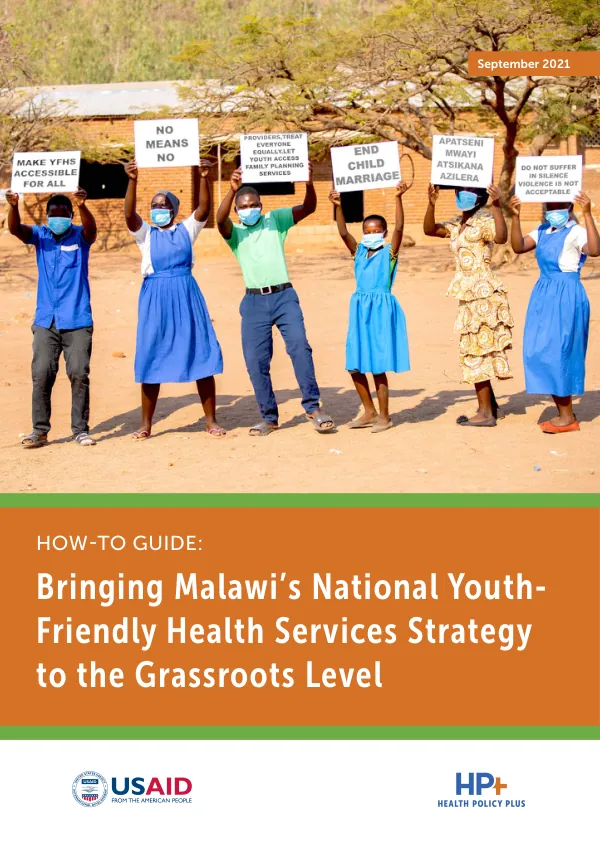
How-to Guide: Bringing Malawi's National Youth-Friendly Health Services Strategy to the Grassroots Level
Sign inAVENIR HEALTH
How-to Guide: Bringing Malawi's National Youth-Friendly Health Services Strategy to the Grassroots Level
Malawi has strong, up-to-date national health policies and strategies, particularly in relation to youth, who make up nearly two-thirds of the country's population.
2021 · 54 pages
Sign in to readA free account is required to download.
Abstract
To effect the positive change they envision, national policies and strategies must be implemented at the grassroots level. The National Youth-Friendly Health Services Strategy (YFHS) aims to improve access to health services for young people in Malawi. The strategy emphasizes the importance of community-level implementation, recognizing that local stakeholders play a crucial role in delivering health services. The YFHS strategy was developed in collaboration with the Malawi Ministry of Health, the Ministry of Education, Science and Technology, the Ministry of Gender, Community Development, and Social Welfare, and the Ministry of Youth and Sports. The strategy focuses on improving access to comprehensive sexuality education, reproductive health services, and HIV prevention and treatment. It also emphasizes the need for community-level engagement and participation in the implementation of the strategy. The Health Policy Plus (HP+) project, funded by the U.S. Agency for International Development (USAID), has been working to support the implementation of the YFHS strategy at the grassroots level. The project has been collaborating with the Malawi Ministry of Health and other stakeholders to develop a five-stage process for strengthening community-level implementation of national policies and strategies. This process involves preparation, co-creating the approach at the national level, entering the district, implementing at the community level, and monitoring and documenting progress. The five-stage process is designed to be flexible and adaptable to the needs of different communities and districts. It emphasizes the importance of community-level engagement and participation in the implementation of the strategy. The process also recognizes the need for ongoing monitoring and evaluation to ensure that the strategy is being implemented effectively and that progress is being made towards the desired outcomes. The HP+ project has been working with stakeholders at the national, district, and community levels to implement the five-stage process. The project has been providing technical and logistical support to help stakeholders develop the necessary capacity and skills to implement the strategy. The project has also been working to build partnerships and collaborations between different stakeholders to ensure that the strategy is being implemented effectively. The implementation of the YFHS strategy at the grassroots level has the potential to make a significant impact on the health and well-being of young people in Malawi. By improving access to comprehensive sexuality education, reproductive health services, and HIV prevention and treatment, the strategy can help to reduce the burden of HIV and other health problems among young people. The strategy can also help to promote healthy behaviors and lifestyles among young people, which can have long-term benefits for their health and well-being.