FUTURES GROUP INTERNATIONAL, LLC
Health Security and Resilience Assessment for Ethiopia
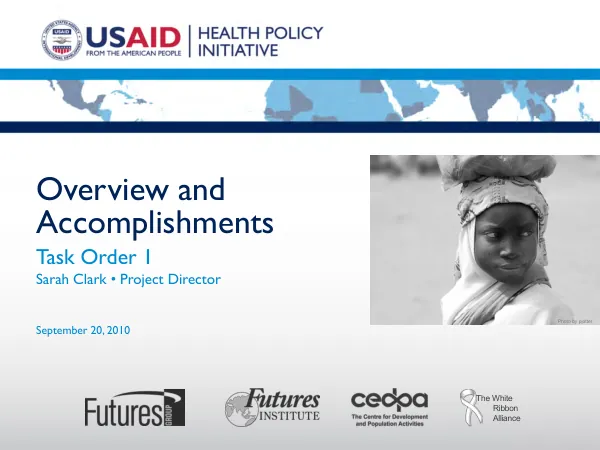
The Health Policy Initiative (HPI) Task Order 1 was a five-year project that spanned from September 30, 2005, to September 29, 2010.
2010 · 37 pages
Sign in to readA free account is required to download.
Abstract
The project received a total of $99 million in funding. The project's primary objective was to improve the enabling environment for health, particularly in the areas of family planning, reproductive health, HIV, and maternal health. The project focused on achieving several key results, including policies that increase access to health services, stronger public and private sector champions, improved access to and use of financial resources, stronger multisectoral engagement and ownership, and better use of data for decision-making. To achieve these results, the project implemented various interventions, including field support, field support was provided to 64% of the project's budget, with a total allocation of $42,222,162. The project also allocated funding to various regions, with 33% of the total budget going to Africa, 17% to Asia, 13% to Latin America and the Caribbean, and 6% to Eastern Europe and Central Asia. The project's global reach was significant, with a presence in multiple regions and a focus on improving health outcomes. The project's objectives were aligned with the goals of the President's Emergency Plan for AIDS Relief (PEPFAR) and the Global Health Initiative. The project's work was also influenced by the reauthorization of PEPFAR and the increasing complexity of the global health landscape. The project's field support was critical in achieving its objectives, with a focus on providing technical assistance, capacity building, and other forms of support to local partners. The project's accomplishments were significant, with a focus on improving policies, strengthening health systems, and increasing access to health services. The project's work in the areas of family planning, reproductive health, HIV, and maternal health was particularly notable, with a focus on improving health outcomes and reducing mortality rates. The project's use of data for decision-making was also a key aspect of its work, with a focus on using data to inform policy and program decisions. The project's impact was significant, with a focus on improving health outcomes and reducing mortality rates. The project's work in the areas of family planning, reproductive health, HIV, and maternal health was particularly notable, with a focus on improving health outcomes and reducing mortality rates. The project's use of data for decision-making was also a key aspect of its work, with a focus on using data to inform policy and program decisions.