USAID DEC
Health Systems Strengthening Practice Spotlight – Contribution Analysis: Capturing the effects of complex health system strengthening activities
Sign inUSAID DEC
Health Systems Strengthening Practice Spotlight – Contribution Analysis: Capturing the effects of complex health system strengthening activities
Contribution analysis is a monitoring, evaluation, research, and learning (MERL) approach used to understand the role an intervention plays in specific outcomes and observed changes in a health system.
2021 · 13 pages
Sign in to readA free account is required to download.
Abstract
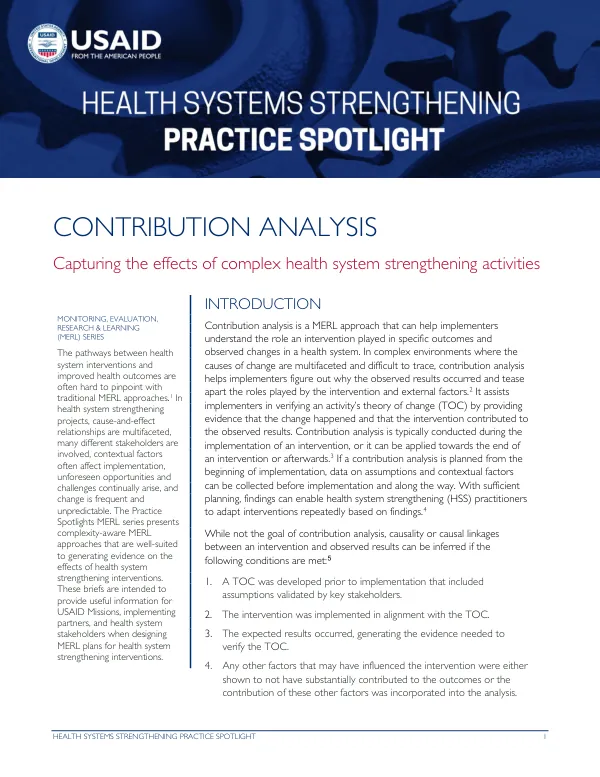
This approach is particularly well-suited to health system strengthening (HSS) activities, where the causes of change are multifaceted and difficult to trace. Contribution analysis helps implementers figure out why observed results occurred and tease apart the roles played by the intervention and external factors. A contribution analysis is typically conducted during the implementation of an intervention, or it can be applied towards the end of an intervention or afterwards. If a contribution analysis is planned from the beginning of implementation, data on assumptions and contextual factors can be collected before implementation and along the way. With sufficient planning, findings can enable HSS practitioners to adapt interventions repeatedly based on findings. Contribution analysis is guided by a clearly articulated theory of change (TOC), which makes the best candidates for this approach. A contribution analysis does not provide definitive proof that an intervention played a role in achieving documented results, but rather produces evidence and a chain of reasoning required to provide a rational explanation of why the results occurred. Contribution analysis acknowledges that an intervention is not implemented in a vacuum, and it accounts for many internal and external factors that may contribute to the results. The six essential steps of a contribution analysis are depicted in Figure 1. These steps include identifying the contribution question, developing the theory of change, collecting data, analyzing the data, drawing conclusions, and communicating the findings. Contribution analysis provides a structured framework for collecting data necessary to validate the sometimes distant link and unclear causality between an HSS intervention and outcomes at any level of the health system. The Maximizing the Quality of Scaling Up Nutrition Plus (MQSUN+) Project is an example of how contribution analysis can be applied to assess the effects of technical assistance on health systems and nutritional status. The project used assumption mapping, which is a type of contribution analysis, to propose possible causal pathways that led to the technical assistance's intended system-level outcomes and impacts. The assumption maps helped the team understand whether the technical assistance in different countries met the assumptions laid out in the intervention. Assumption mapping is a key component of contribution analysis, and it involves visually representing the pathway from systems-level interventions to nutrition impact. The maps have a similar structure to a TOC, detailing activities, outputs, outcomes, impacts, and associated assumptions. Assumption mapping provides a value-add by demonstrating how the intervention contributed to the project's and FCDO's visions and objectives. The MQSUN+ team continuously collected the necessary evidence to validate the contribution story through regular programmatic meetings. After developing the methodology in the first year of the project, the team consolidated data and updated the contribution story annually. The assumption map served as a framework to help the team understand whether the technical assistance in different countries met the assumptions laid out in the intervention. Contribution analysis is a useful approach for understanding the role of interventions in health system strengthening. It provides a structured framework for collecting data necessary to validate the sometimes distant link and unclear causality between an HSS intervention and outcomes at any level of the health system. By incorporating evidence on the effects of assumptions and external factors, contribution analysis offers plausibility in establishing causal links where traditional monitoring and evaluation approaches may not be possible.