USAID DEC
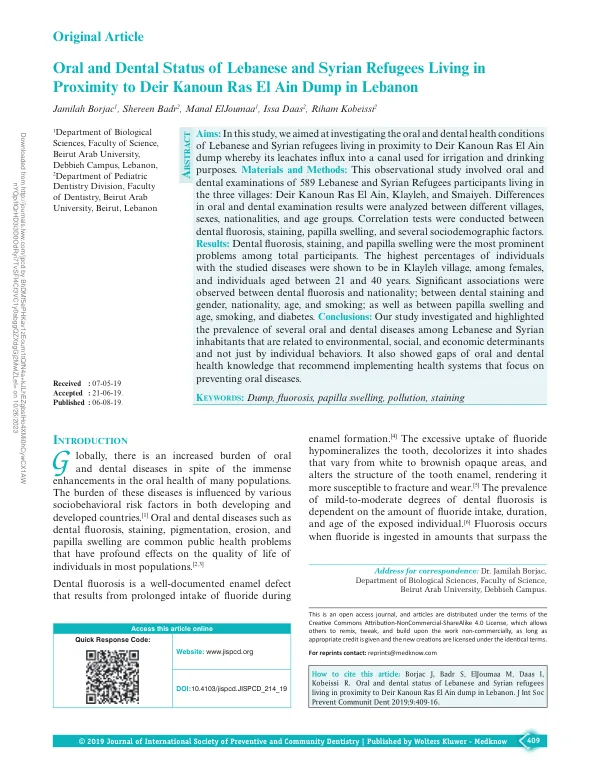
Heavy metals and organic compounds contamination in leachates collected from Deir Kanoun Ras El Ain dump and its adjacent canal in South Lebanon
Sign inUSAID DEC
Heavy metals and organic compounds contamination in leachates collected from Deir Kanoun Ras El Ain dump and its adjacent canal in South Lebanon
Heavy metals and organic compounds contamination in leachates collected from Deir Kanoun Ras El Ain dump and its adjacent canal in South Lebanon is a significant environmental concern.
2019 · 7 pages
Sign in to readA free account is required to download.
Abstract
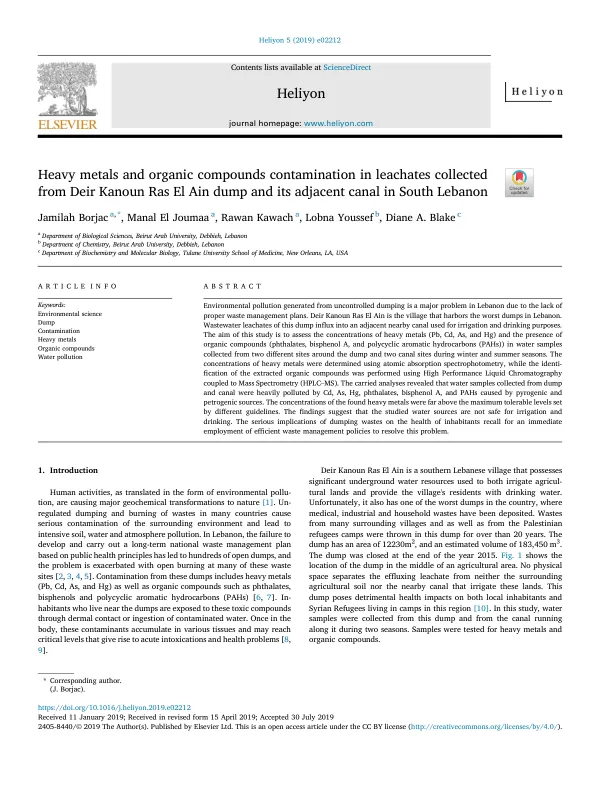
The dump, located in the village of Deir Kanoun Ras El Ain, is one of the worst in Lebanon, with an area of 12230m2 and an estimated volume of 183,450 m3. The dump has been in operation for over 20 years, receiving medical, industrial, and household wastes from surrounding villages and Palestinian refugee camps. The leachates from the dump have been found to contaminate the adjacent canal, which is used for irrigation and drinking purposes. The canal's water sources are not safe for irrigation and drinking due to the presence of heavy metals and organic compounds. The concentrations of heavy metals, including lead (Pb), cadmium (Cd), arsenic (As), and mercury (Hg), were found to be far above the maximum tolerable levels set by different guidelines. The study, conducted by researchers from Beirut Arab University and Tulane University School of Medicine, aimed to assess the concentrations of heavy metals and organic compounds in water samples collected from two different sites around the dump and two canal sites during winter and summer seasons. The researchers used atomic absorption spectrophotometry to determine the concentrations of heavy metals and High Performance Liquid Chromatography coupled to Mass Spectrometry (HPLC-MS) to identify the extracted organic compounds. The results showed that the water samples collected from the dump and canal were heavily polluted by Cd, As, Hg, phthalates, bisphenol A, and polycyclic aromatic hydrocarbons (PAHs) caused by pyrogenic and petrogenic sources. The concentrations of the found heavy metals were far above the maximum tolerable levels set by different guidelines. The findings suggest that the studied water sources are not safe for irrigation and drinking. The study's results have serious implications for the health of inhabitants living in the region, including local residents and Syrian refugees. The researchers recommend the immediate employment of efficient waste management policies to resolve this problem. The study highlights the need for effective waste management practices to prevent environmental pollution and protect public health. The researchers collected water samples from four sites: two from the canal and two from the dump. The samples were collected during the winter and summer seasons of 2017. The concentrations of heavy metals were determined using atomic absorption spectrophotometry, while the identification of the extracted organic compounds was performed using HPLC-MS. The results showed that the water samples collected from the dump and canal were heavily polluted by Cd, As, Hg, phthalates, bisphenol A, and PAHs. The concentrations of heavy metals in water samples collected during winter and summer seasons are summarized in Table 2. The results showed that Pb, Cd, As, and Hg were abundant in the water samples collected from the dump and canal. The concentrations of Pb, As, Cd, and Hg at C2, which is the furthest site from the dump, showed an increasing pattern when compared to those at C1. The concentrations of Pb and Cd at D1, which is the site closest to the dump, were higher than those at D2. The study's findings have significant implications for environmental pollution and public health. The researchers recommend the implementation of efficient waste management policies to prevent environmental pollution and protect public health. The study highlights the need for effective waste management practices to prevent the contamination of water sources and protect the health of inhabitants living in the region.
Related documents
![Championing economic growth best practices in Asia and the Middle East : Asia and Middle East economic growth and best practices project [final report]](https://covers.devme.ai/gen/97302.webp)