AMERICAN ASSOCIATION OF COMMUNITY COLLEGES
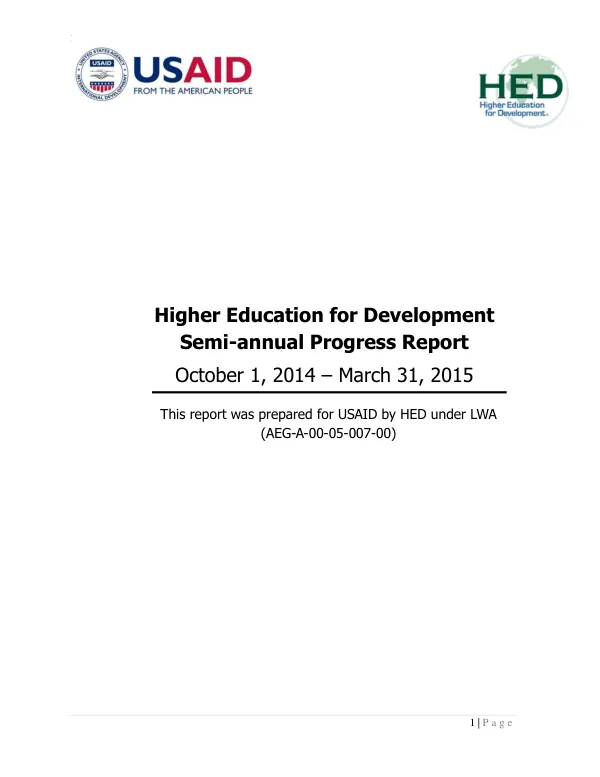
HED-USAID Semiannual Progress Report
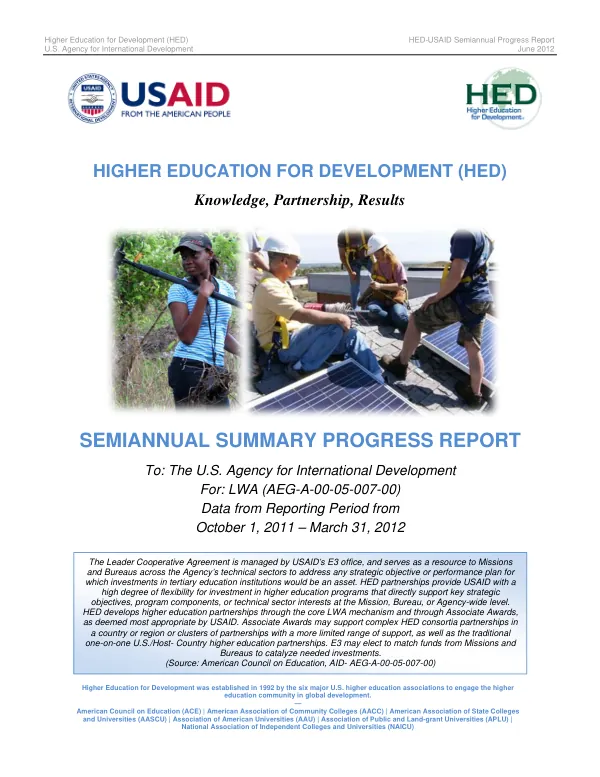
Higher Education for Development (HED) was established in 1992 by six major U.S.
2012 · 127 pages
Sign in to readA free account is required to download.
Abstract
higher education associations to engage the higher education community in global development. The organization's primary goal is to leverage the expertise and resources of the U.S. higher education sector to address global development challenges. HED's partnerships provide the U.S. Agency for International Development (USAID) with a high degree of flexibility for investment in higher education programs that directly support key strategic objectives, program components, or technical sector interests at the Mission, Bureau, or Agency-wide level. HED's partnerships are managed through the core Leader Cooperative Agreement (LWA) mechanism and through Associate Awards, as deemed most appropriate by USAID. Associate Awards may support complex HED consortia partnerships in a country or region or clusters of partnerships with a more limited range of support, as well as the traditional one-on-one U.S./Host-Country higher education partnerships. E3 may elect to match funds from Missions and Bureaus to catalyze needed investments. The Leader Cooperative Agreement is managed by USAID's E3 office and serves as a resource to Missions and Bureaus across the Agency's technical sectors to address any strategic objective or performance plan for which investments in tertiary education institutions would be an asset. HED develops higher education partnerships through the core LWA mechanism and through Associate Awards, as deemed most appropriate by USAID. During the reporting period from October 1, 2011, to March 31, 2012, HED made significant progress in achieving its objectives. The organization successfully designed and distributed Requests for Application (RFAs) for funding opportunities, with a total of 15 RFAs advertised and 24 applications received. Peer reviews and recommendations for funding resulted in the selection of 12 collaborative partnerships, which were funded and supported 25 higher education institutions. HED also made progress in institutional capacity development, with a focus on research, outreach/extension activities, and human capacity development. The organization supported 15 joint research projects, 10 outreach/extension activities, and provided training to 1,200 students, 150 faculty members, and 200 short-term training participants. Additionally, HED provided technical assistance field visits, technical assistance requests, and research studies, roundtables, and conferences. The organization's results-based management, monitoring, evaluations/assessments, and research efforts were also notable, with a focus on evaluations/assessments, monitoring, HED performance management processes, and research. HED's performance management processes were strengthened, and the organization conducted evaluations/assessments, monitoring, and research to inform its programming and decision-making. In addition to its progress in achieving its objectives, HED also reported additional achievements and challenges. The organization's partnerships with higher education institutions and other stakeholders resulted in significant achievements, including the development of new programs, research initiatives, and capacity-building activities. However, HED also faced challenges, including the need to strengthen its systems and processes, improve its monitoring and evaluation capacity, and enhance its research and technical assistance efforts. Moving forward, HED plans to continue its partnership development efforts, providing technical assistance to higher education institutions, and conducting workshops, roundtables, and conferences to promote collaboration and knowledge-sharing. The organization also plans to strengthen its systems and processes, improve its monitoring and evaluation capacity, and enhance its research and technical assistance efforts to better support the needs of its partners and stakeholders.