AMERICAN ASSOCIATION OF COMMUNITY COLLEGES
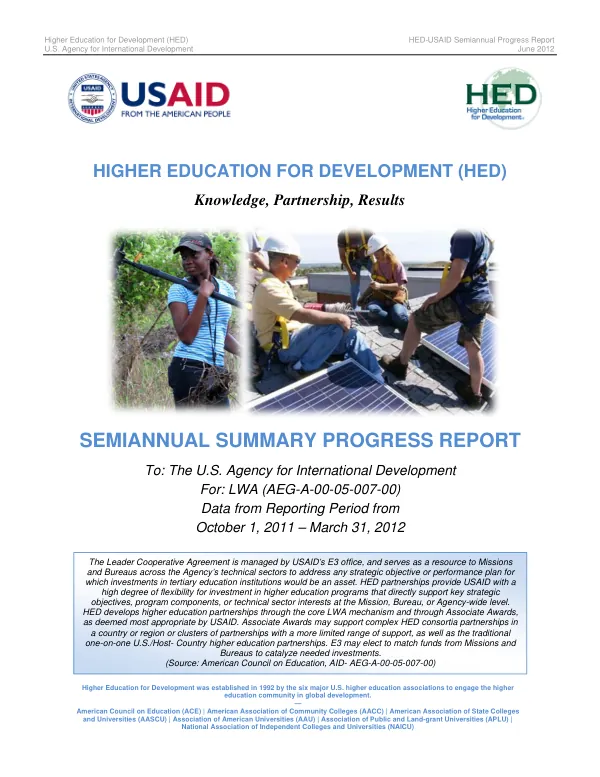
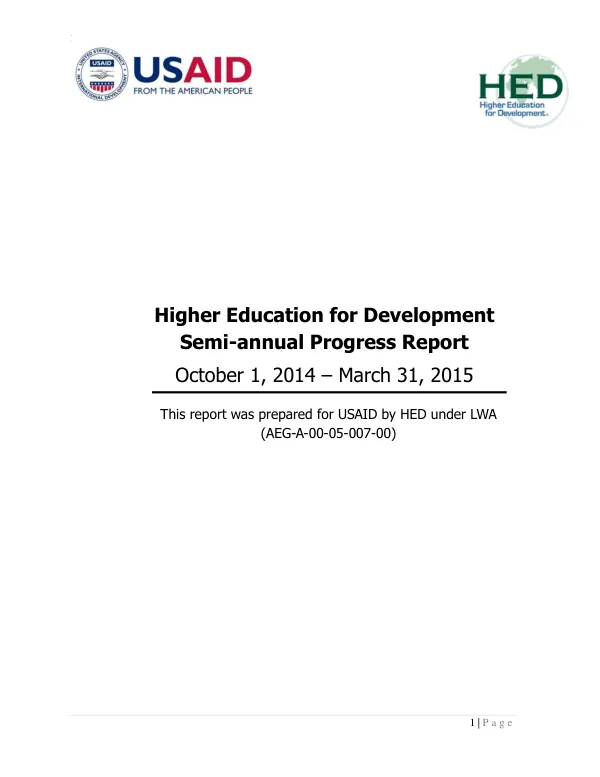
Semi-annual Progress Report: Higher Education for Development (HED) Partnerships
Higher Education for Development (HED) mobilizes the expertise and resources of the higher education community to address global development challenges by facilitating and managing higher education partnerships.
2015 · 36 pages
Sign in to readA free account is required to download.
Abstract
Funded by the U.S. Agency for International Development (USAID) and the U.S. Department of State, HED partnerships carry out a range of activities to promote educational effectiveness, strengthen institutional systems and organizational development, and facilitate strategic alliances among higher education institutions, government, and other entities. Enhancing these aspects of higher education results in shared knowledge and a competent workforce that can lead to innovation and policy change for the ultimate purpose of advancing broader human and social development goals in society. During the first half of FY 2015, HED managed 31 active partnerships in 26 host countries. Partners reported implementation of 126 outreach/extension activities in the host-country community, and provided 125 short-term training opportunities to 2,211 individuals affiliated with host-country institutions. The training opportunities included 1,182 female and 1,029 male participants. HED's partnerships aim to promote a culture of continuous learning and improvement within and outside the walls of institutions, supporting policy changes and creating enabling environments to facilitate development. HED was founded in 1992 by six major U.S. higher education associations to advance the engagement of the higher education community in addressing development challenges around the world. HED's model is based on its theory of change, which posits that higher education institutions are key to economic growth and the advancement of societies. Higher education contributes to creating new bodies of knowledge and bringing innovative solutions to market, engaging active and emergent leadership, and building a competent workforce. HED receives funding from USAID's Bureau for Economic Growth, Education and Environment, Office of Education (E3/ED) through a Leader with Associates (LWA) cooperative agreement, from USAID's functional and regional Bureaus and worldwide Missions, and from the U.S. Department of State. The LWA Cooperative Agreement between USAID and ACE/HED outlines seven performance objectives. Objective 1 aims to design Request for Applications resulting in 10 or more collaborative partnerships. Objective 2 focuses on widely distributing RFAs and conducting fair and transparent application review and nomination processes. Objective 3 aims to improve institutional capacity to offer technical assistance for addressing development goals in host countries. Objective 4 aims to improve human capacity of higher education professionals to address teaching, research, and public service. Objective 5 focuses on securing advisory assistance/expertise from the higher education community to support USAID Bureaus, Missions, and technical sectors' strategic objectives. Objective 6 aims to sponsor/promote research studies, roundtables, and conferences related to global development issues. Objective 7 focuses on documenting partnership development results and proceeding toward a complete and orderly closeout of the program. HED's partnerships have resulted in improved institutional capacity, human capacity, and advisory assistance. The partnerships have also led to the promotion of research studies, roundtables, and conferences related to global development issues. HED's model has been successful in advancing the engagement of the higher education community in addressing development challenges around the world.
Related documents