USAID DEC
Hepatitis B prevalence and incidence in the fishing communities of Lake Victoria, Uganda: a retrospective cohort study
Sign inWORLD HEALTH ORGANIZATION
Hepatitis B prevalence and incidence in the fishing communities of Lake Victoria, Uganda: a retrospective cohort study
Hepatitis B prevalence and incidence in the fishing communities of Lake Victoria, Uganda, were assessed in a retrospective cohort study.
2021 · 8 pages
Sign in to readA free account is required to download.
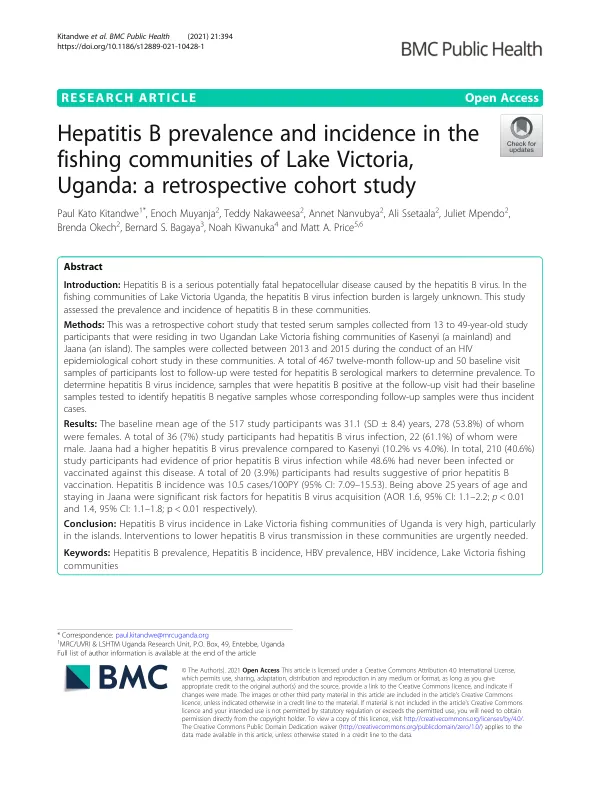
Abstract
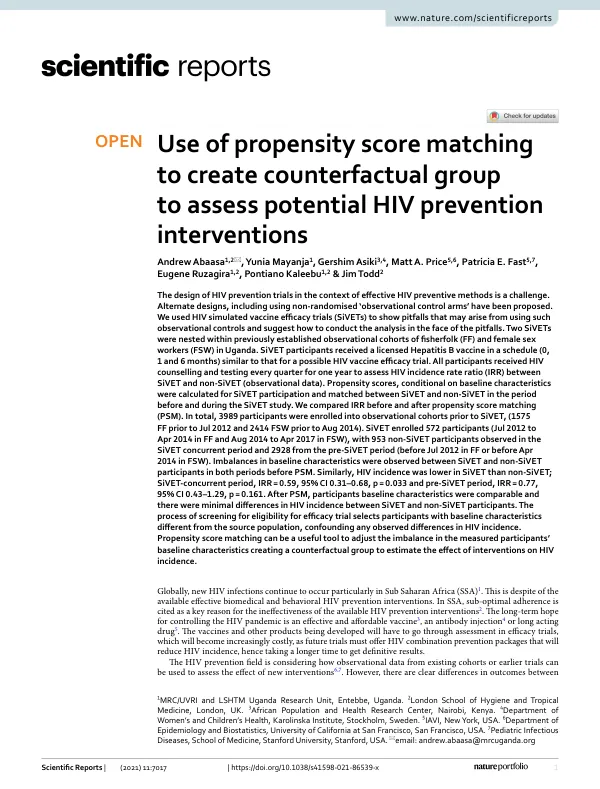
The study population consisted of 13 to 49-year-old residents of two fishing communities, Kasenyi and Jaana, who were randomly selected from an updated census database. The study participants were residents in these communities for at least 6 months at the time the cohort study was conducted. A total of 517 study participants were included in the analysis, with a mean age of 31.1 years (SD ± 8.4) and 278 (53.8%) females. The study found that 36 (7%) study participants had hepatitis B virus infection, with 22 (61.1%) males. Jaana had a higher hepatitis B virus prevalence compared to Kasenyi, with 10.2% and 4.0% respectively. A total of 210 (40.6%) study participants had evidence of prior hepatitis B virus infection, while 48.6% had never been infected or vaccinated against this disease. Hepatitis B incidence was 10.5 cases/100 person-years (95% CI: 7.09–15.53). Being above 25 years of age and residing in Jaana were significant risk factors for hepatitis B virus acquisition. The study used archived serum samples collected during an HIV epidemiological cohort study conducted in 10 fishing communities of Lake Victoria, Uganda between 2013 and 2015. The samples were tested for hepatitis B serological markers, including HBV surface antigen (HBsAg), HBV core antibodies (anti-HBc), and HBV surface antibodies (anti-HBs). The results were categorized into one of five groups: actively infected, previously infected or resolved infection, vaccinated, susceptible or HBV naive, and indeterminate results. The anti-HBs titer cut-off value was 10 IU/L. The study's findings suggest that hepatitis B virus incidence in Lake Victoria fishing communities of Uganda is very high, particularly in the islands. Interventions to lower hepatitis B virus transmission in these communities are urgently needed. The study's results highlight the importance of targeting high-risk populations, such as fishing communities, in efforts to control hepatitis B virus transmission. The study's findings also emphasize the need for further research to understand the epidemiology of hepatitis B virus in these communities and to develop effective prevention and control strategies. The study's methodology involved testing archived serum samples collected during an HIV epidemiological cohort study. The samples were tested for hepatitis B serological markers, and the results were categorized into one of five groups. The study's results were analyzed using statistical methods to determine the prevalence and incidence of hepatitis B virus infection. The study's findings were compared to previous studies to understand the epidemiology of hepatitis B virus in the fishing communities of Lake Victoria, Uganda. The study's results have implications for public health policy and practice in Uganda. The high prevalence of hepatitis B virus infection in the fishing communities of Lake Victoria highlights the need for targeted interventions to control the spread of the virus. The study's findings also emphasize the importance of incorporating hepatitis B virus testing and vaccination into HIV prevention and treatment programs in these communities.