USAID DEC
Use of propensity score matching to create counterfactual group to assess potential HIV prevention interventions
Sign inLONDON SCHOOL OF HYGIENE & TROPICAL MEDICINE
Use of propensity score matching to create counterfactual group to assess potential HIV prevention interventions
HIV prevention trials in the context of effective HIV preventive methods pose a significant challenge.
2021 · 11 pages
Sign in to readA free account is required to download.
Abstract
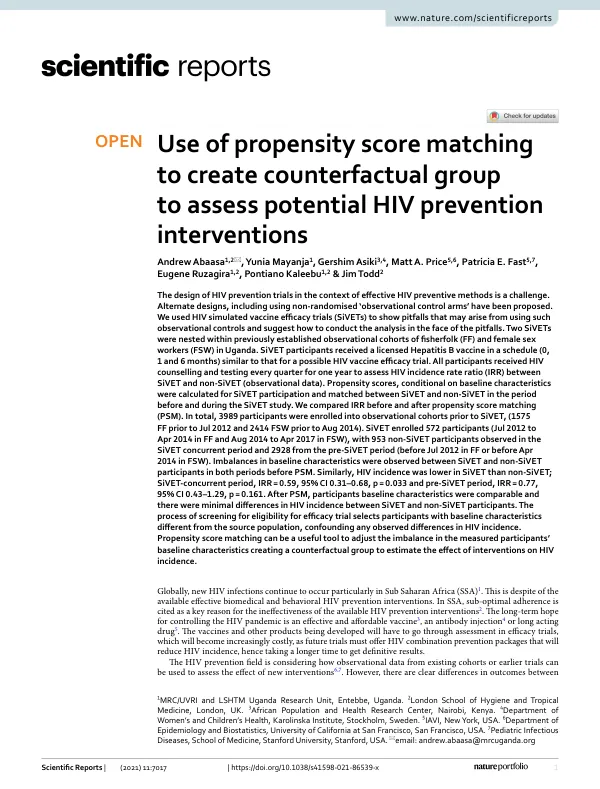
Alternate designs, including the use of non-randomized 'observational control arms,' have been proposed to address this challenge. However, these designs may lead to pitfalls, such as selection bias and differences in outcomes between participants who join trials and those who do not. To mitigate these issues, researchers have suggested using propensity score matching (PSM) to create a counterfactual group that is comparable to the observational control arm. PSM is a statistical technique that estimates the probability of treatment assignment conditional on measured baseline characteristics. By matching participants based on these characteristics, researchers can create a non-randomized but comparable counterfactual group that provides a less biased estimate of HIV incidence. The simulated vaccine efficacy trial (SiVET) concept has been proposed to provide trial context data through a 'simulated' trial using a commercially licensed vaccine. This concept helps to inform the design and sample size estimation for clinical trials. Between July 2012 and August 2017, two SiVETs were nested within observational cohorts of female sex workers and fisherfolk sub-populations in Uganda to provide an HIV vaccine efficacy trial platform and estimate HIV incidence. The study used data from three observational cohorts, two in fishing communities and one among female sex workers, all in Uganda. The observational cohorts were established to determine the feasibility of enrolling and following fisherfolk and female sex workers in an observational cohort and to determine HIV incidence. The study aimed to create a counterfactual group from observational data that is comparable to SiVET and estimate and compare HIV incidence between observational cohorts and SiVETs before and after propensity score matching in two distinct key populations. The fisherfolk observational cohorts were recruited from fishing communities on the shoreline of Lake Victoria in Entebbe and Masaka, Uganda. The main economic activity in these communities is fishing, but other occupations such as fish processing, small-scale businesses, and entertainment also support the fishing activity. The population is characterized by very high HIV prevalence, 20-30%, and annual incidence, 3-11%, with more than 50% reporting frequent high-risk sexual behavior. The female sex worker population's observational cohort was located within Kampala city, and women in sex work operate from HIV hotspots defined as nightclubs, entertainment facilities, restaurants/hotels, lodges, and bars conducive for meeting male clients. The prevalence and annual incidence of HIV are reported to be very high, 37%, and 3%, respectively, and more than 90% of these women report frequent high-risk sexual behavior. The study used data from three observational cohorts, two fisherfolk cohorts, and one female sex worker cohort, conducted from February 2009 to April 2015 and from April 2008 to April 2017. The study staff provided HIV counseling and testing (HCT) to potential participants, and those found to be HIV negative, aged 18-49 years, were enrolled into an observational cohort at a clinic established in each of five participating fishing communities. Repeat HCT was performed every 6 months for 18 months. The study found that imbalances in baseline characteristics were observed between SiVET and non-SiVET participants in both periods before propensity score matching. Similarly, HIV incidence was lower in SiVET than non-SiVET; SiVET-concurrent period, IRR = 0.59, 95% CI 0.31-0.68, p = 0.033, and pre-SiVET period, IRR = 0.77, 95% CI 0.43-1.29, p = 0.161. After propensity score matching, participants' baseline characteristics were comparable, and there were minimal differences in HIV incidence between SiVET and non-SiVET participants. The study suggests that propensity score matching can be a useful tool to adjust the imbalance in measured participants' baseline characteristics, creating a counterfactual group to estimate the effect of interventions on HIV incidence. The study's findings have implications for the design and analysis of HIV prevention trials, particularly in the context of effective HIV preventive methods.