GOVERNMENT OF UGANDA
Ten Factors for Viable Rural Water Services
The rural water services in Uganda face significant challenges, with 30 percent of the rural population lacking access to a hand pump for safe drinking water.
2021 · 14 pages
Sign in to readA free account is required to download.
Abstract
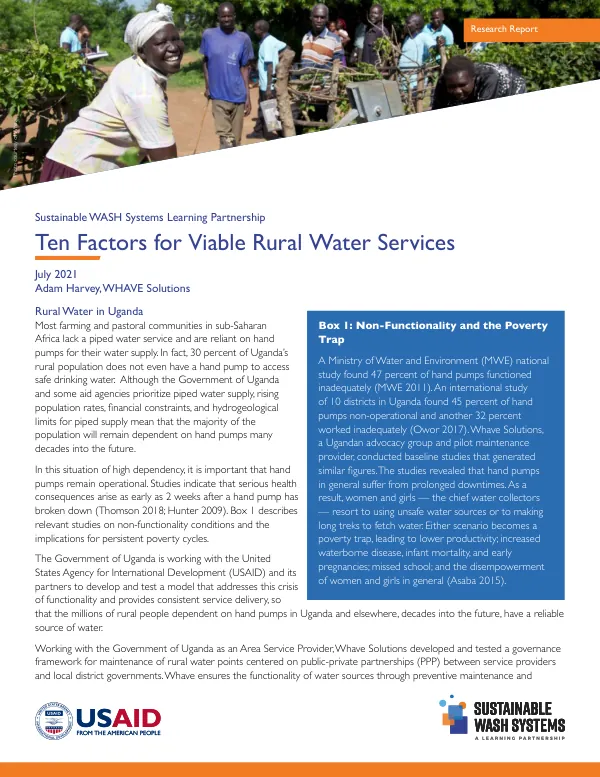
The Government of Uganda and aid agencies prioritize piped water supply, but rising population rates, financial constraints, and hydrogeological limits mean that the majority of the population will remain dependent on hand pumps for many decades. In this situation, it is crucial that hand pumps remain operational, as studies indicate that serious health consequences arise as early as 2 weeks after a hand pump has broken down. The Government of Uganda is working with the United States Agency for International Development (USAID) and its partners to develop and test a model that addresses the crisis of functionality and provides consistent service delivery. Whave Solutions, a Ugandan advocacy group and pilot maintenance provider, has developed and tested a governance framework for maintenance of rural water points centered on public-private partnerships (PPP) between service providers and local district governments. Whave ensures the functionality of water sources through preventive maintenance and pays local technicians on a performance basis to repair hand pumps. The Whave model involves signing performance contracts between the Area Service Provider and local district governments, regulating key points such as the performance review schedule and tariff rates. Once a contract is in place, Whave signs service agreements with communities that allow it to oversee the maintenance of the community's water source and collect fees from water users on an annual basis with installment options. Whave contracts with local technicians to provide monthly preventive maintenance and rapidly respond to breakdowns, and provides them with quality spare parts to make all necessary repairs. Whave has demonstrated its ability to maintain high levels of functionality, consistently above 97 percent, while maintaining payment compliance and minimizing the number and duration of breakdowns through preventive maintenance. Quarterly measures of "spot-functionality" have been 12 percent to 32 percent higher than at baseline, and on average less than 10 percent of sources needed a repair in a given quarter. Repair time is under 2 days in more than 80 percent of cases of breakdown, and 100 percent in less than 5 days. The Whave model is being studied and documented in detail as part of the USAID Sustainable WASH Systems Learning Partnership's investigation of systems-based approaches. The partnership focuses on how different maintenance models for rural water services operate and the characteristics of the systems in which they function. The Whave model has been piloted in 11 districts in four regions, servicing more than 600 communities as of May 2021. The Ministry of Water and Environment (MWE) has introduced the Operation and Maintenance Framework for Rural Water Infrastructure (O&M Framework), also known as the Professional Management Approach (PMA) and CBMS+. The framework requires each local government water authority to contract a professional maintenance entity, known as an Area Service Provider, to take responsibility for functionality assurance and maintenance services. The Area Service Provider contracts local mechanics and collects maintenance fees from water users. The Whave model has been adopted as the core element of the new national O&M Framework, and Whave has demonstrated its ability to maintain high levels of functionality, consistently above 97 percent, while maintaining payment compliance and minimizing the number and duration of breakdowns through preventive maintenance. The data from Whave's rigorous monitoring and the success of its management model have served as the foundation for the government's adoption of Whave's PPP approach.