CHEMONICS
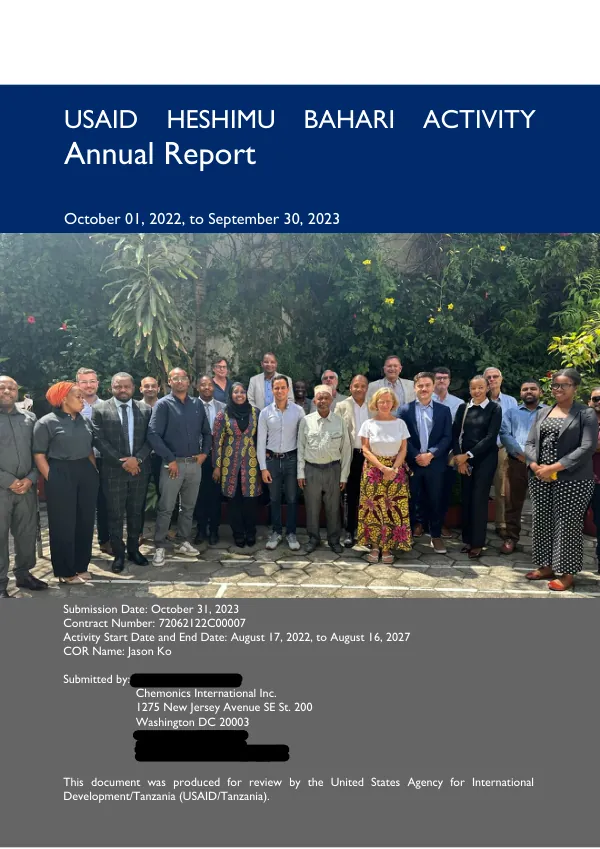
Heshimu Bahari Monitoring, Evaluation and Learning (MEL) Plan
The Heshimu Bahari Activity is a five-year project implemented by Chemonics International, in partnership with The Nature Conservancy and Wildlife Conservation Society, with funding from the United States Agency for International Development (USAID) in Tanzania.
2023 · 112 pages
Sign in to readA free account is required to download.
Abstract
The project aims to improve the management of marine resources in Tanzania, with a focus on the marine management areas (MMAs) and fishery replenishment zones (FRZs). The project's guiding principles include focusing on the enabling environment, including local communities, engaging the private sector, and enhancing data access and visibility. These principles inform the project's learning agenda and guide the collection of data for reflection sessions and adaptive management. The project's monitoring, evaluation, and learning (MEL) plan is designed to track progress towards the project's core expected results, which include improving the management of MMAs and FRZs, enhancing the capacity of local communities to manage marine resources, and promoting sustainable fishing practices. The plan includes indicators and other data needed to assess achievement of these results, as well as evaluation and learning data required to understand key elements of the project's theory of change. The MEL plan is organized around the key learning objectives identified by core project stakeholders, including the USAID Mission, the Government of Tanzania, and local communities. The plan includes a monitoring plan, a beneficiary feedback plan, an evaluation plan, and a collaborating, learning, and adapting (CLA) plan. The monitoring plan outlines the processes and procedures for collecting and analyzing data on project progress, including the use of performance indicator tracking tables and data quality assessments. The beneficiary feedback plan describes the mechanisms for collecting feedback from project beneficiaries, including surveys and focus group discussions. The evaluation plan outlines the approach and methodology for evaluating project impact, including the use of logical frameworks and results frameworks. The CLA plan describes the processes and procedures for promoting collaboration, learning, and adapting among project stakeholders, including the use of knowledge management systems and adaptive management tools. The project's MEL plan is a dynamic and flexible document that will be updated throughout the implementation process, with new targets or approaches incorporated based on implementation context and evolving priorities of the USAID Mission. The plan is designed to provide opportunities for learning and adaptive management based on a wide variety of data sources, including indicator results, implementation updates, assessments, and data collection stemming from the learning agenda. The project's management structures will provide opportunities for MEL capacity building for project staff, key partners, grantees, and stakeholder staff as needed. The Knowledge Management Lead, with support from WCS and Chemonics' Washington office, will provide regular opportunities for MEL capacity building and adaptive management. The project's geographic coverage includes Tanzania (mainland and Zanzibar), with a focus on the MMAs and FRZs. The project's contract number is 72062122C00007, and the prime implementing partner is Chemonics International Inc. The subcontractors/sub-awardees include The Nature Conservancy and Wildlife Conservation Society. The project's guiding principles and MEL plan are designed to promote sustainable management of marine resources in Tanzania, with a focus on the MMAs and FRZs. The project's approach is informed by the USAID standard reference documents, including the Country Development Cooperation Strategy (CDCs), Results Framework (RF), and Monitoring, Evaluation and Learning (MEL) policy.
Related documents