CHEMONICS
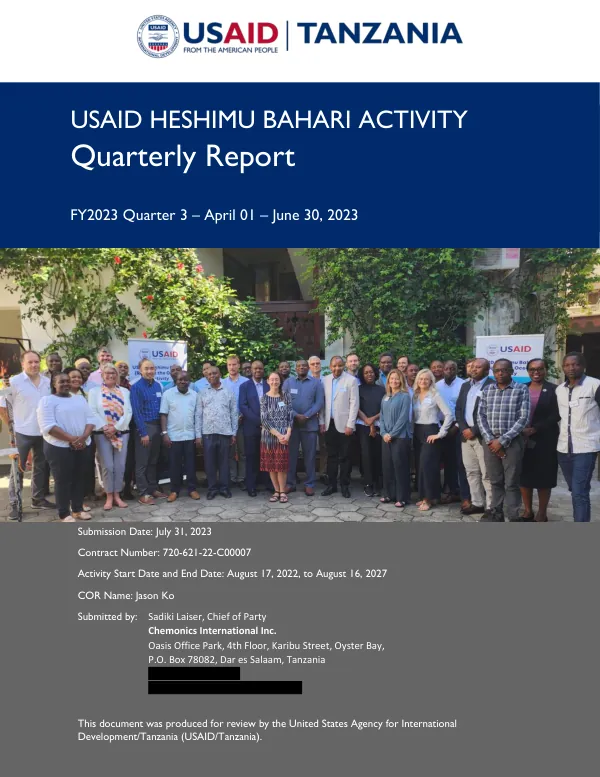
USAID/Tanzania Heshimu Bahari Activity Quarterly Report FY2023 Quarter 3
The Heshimu Bahari Activity is a USAID-funded project implemented by Chemonics International Inc.
2023 · 34 pages
Sign in to readA free account is required to download.
Abstract
in Tanzania, with a focus on marine conservation and sustainable fisheries management. The project aims to expand the collaborative network of Marine Managed Areas (MMAs) and Fisheries Replenishment Zones (FRZs), strengthen community co-management of MMAs and wild-caught fisheries, and promote private sector investment in MMAs and wild-caught fisheries. The project has made significant progress in Q3, with the signing of two memoranda of understanding (MoU) with the Ministry of Blue Economy and Fisheries (MoBEF)-Zanzibar and the Ministry of Livestock and Fisheries (MLF)-Mainland. The MoUs aim to strengthen collaboration and coordination between the government and the project in achieving the project's objectives. The project also conducted its annual Pause and Reflect meeting, which brought together representatives from the MoBEF, MLF, USAID/Tanzania, USAID/Washington, consortium partners, and conservation stakeholders. The meeting evaluated the project's theory of change and results chain and aligned climate change and illegal fishing with the existing res. The project has made progress in implementing its objectives, including the expansion of the collaborative network of MMAs and FRZs. The project has also strengthened community co-management of MMAs and wild-caught fisheries, with a focus on promoting sustainable fishing practices and reducing bycatch. In terms of private sector investment, the project has made progress in promoting investment in MMAs and wild-caught fisheries. The project has also strengthened its collaboration with the private sector, including through the signing of a MoU with a private sector partner. The project has also made progress in integrating cross-cutting issues, including gender equality and women's empowerment, youth engagement, and sustainability. The project has also strengthened its collaboration with other stakeholders, including government agencies, civil society organizations, and the private sector. The project's monitoring, evaluation, and learning (MEL) system has been strengthened, with the implementation of a new MEL framework. The project has also conducted regular monitoring and evaluation activities, including the collection of data on project outcomes and impacts. The project's financial management has been strengthened, with the implementation of a new financial management system. The project has also conducted regular financial reporting and budgeting activities, including the submission of quarterly financial reports to USAID. Overall, the Heshimu Bahari Activity has made significant progress in Q3, with a focus on implementing its objectives and strengthening its collaboration with stakeholders. The project continues to work towards its goal of promoting sustainable fisheries management and marine conservation in Tanzania. The project's geographic coverage includes Tanzania (Unguja, Pemba, Tanga, Pwani), with a focus on the coastal regions. The project's reporting period is from April 1, 2023, to June 30, 2023, with a focus on Q3 of Fiscal Year 2023. The project's key highlights during Q3 include the signing of two MoUs with the MoBEF-Zanzibar and MLF-Mainland, the conduct of the annual Pause and Reflect meeting, and the strengthening of community co-management of MMAs and wild-caught fisheries. The project also promoted private sector investment in MMAs and wild-caught fisheries and strengthened its collaboration with the private sector. The project's implementation is led by Chemonics International Inc., with the support of subcontractors The Nature Conservancy (TNC) and Wildlife Conservation Society (WCS). The project's major counterpart organizations include the Ministry of Blue Economy and Fisheries, Ministry for Livestock and Fisheries, President Office Regional Administration and Local Government, and Ministry of Natural Resources and Tourism.