CHEMONICS
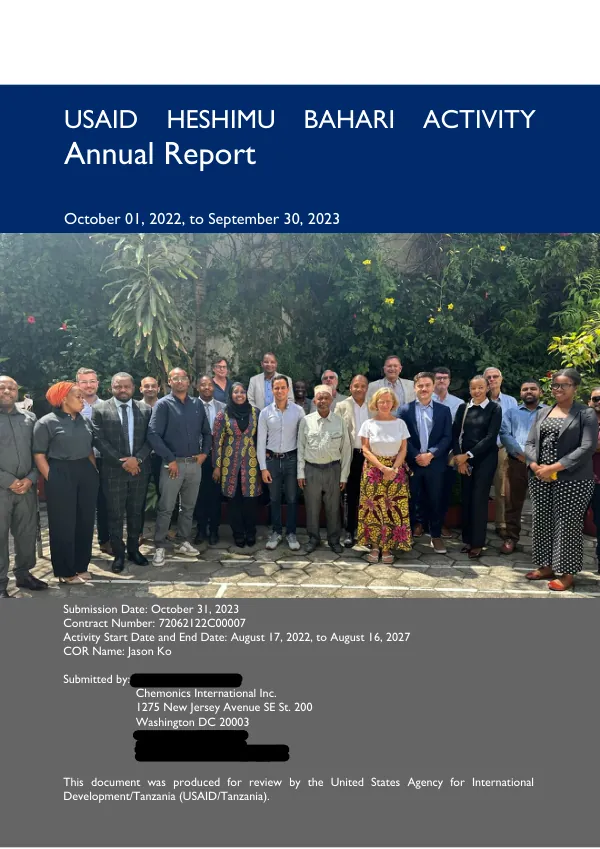
USAID Heshimu Bahari Activity Annual Report
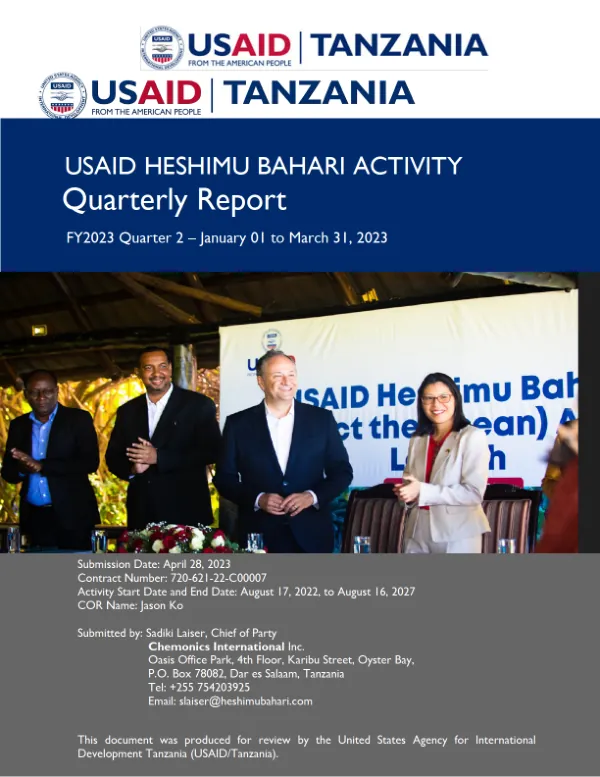
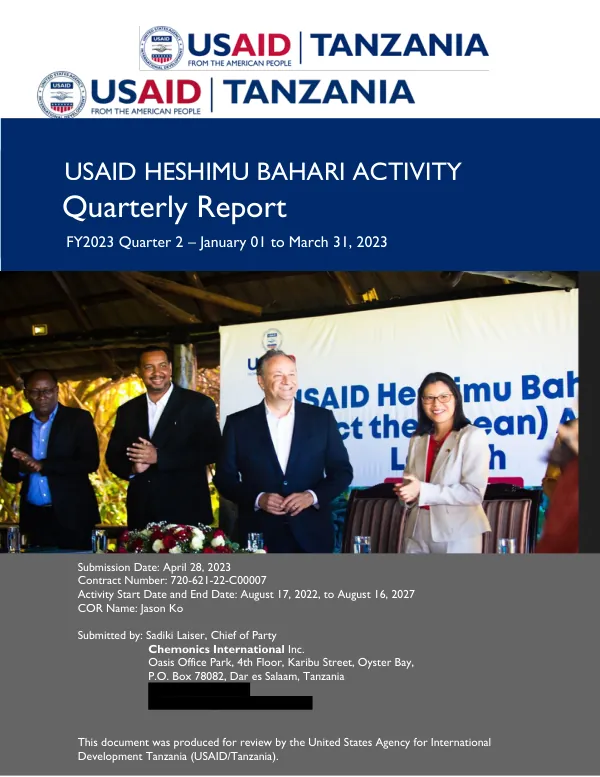
The USAID Heshimu Bahari Activity aims to enhance the ecological resilience and productivity of high marine biodiversity areas in Tanzania.
2023 · 35 pages
Sign in to readA free account is required to download.
Abstract
The Activity seeks to create a conducive environment and a science-based framework for the sustainable co-management of Marine Management Areas (MMAs) and wild-caught fisheries. This co-management approach involves the active participation of the government, local community, and the private sector in MMAs/Fisheries Replenishment Zones (FRZs). The Activity encompasses four interconnected objectives: enhancing the establishment of a supportive framework for a network of MMAs and FRZs, fostering climate resilient communities, and enhancing wild-caught fisheries productivity. During the first year of implementation, the primary objective was to lay the groundwork for the establishment of FRZs through the collection of baseline data. The Activity initially covered eight seascapes in the islands of Unguja and Pemba in Zanzibar, and Tanga, Pangani, and Bagamoyo in Tanzania Mainland. In July 2023, the Activity expanded its geographic scope to Dar es Salaam, Mafia-Kilwa, and Mtwara in Tanzania Mainland and East Unguja for a total of 12 seascapes. The Activity established strong relations with key stakeholders, including government and implementing partners, and initiated baseline studies necessary for FRZs establishment and strengthening of MMAs, community FRZs/MMAs co-management, private sector engagement, and science-informed policy and decision-making. The Activity engaged with national and local governments, including the Ministry of Blue Economy and Fisheries-Zanzibar (MoBEF) and the Ministry of Fisheries and Livestock-Mainland Tanzania (MLF). The Activity's relationships with the national and local government are essential for the successful implementation of the Activity's objectives. The Activity also faced some challenges, including the slow pace of government buy-in to the FRZs establishment and strengthening of MMAs, which resulted in delayed signing of Memoranda of Understanding (MoU). Additionally, rough seas weather seasons disrupted Benthic Ecological Surveys (BES) and Fish Pattern Mapping (FPM), which were the precursor for establishment of the Fisheries Replenishment Zones. The Activity's Annual Pause and Reflect informed the development of the Year 2 Whole of Activity Result Chain, the Year 2 Work Plan, and the revised Monitoring, Evaluation and Learning (MEL) Plan. The Activity's progress during the reporting period was significant, including stakeholder engagement, partner mobilization, resource identification and mobilization, and establishment of necessary baseline information for the succeeding years of implementation. The Activity's expansion to new seascapes and its engagement with national and local governments are crucial steps towards achieving its objectives. The Activity's objectives are aligned with the Tanzanian government's priorities, including the enhancement of marine biodiversity conservation, climate resilience, and sustainable fisheries management. The Activity's co-management approach involves the active participation of the government, local community, and the private sector in MMAs/Fisheries Replenishment Zones. This approach is essential for the successful implementation of the Activity's objectives and the achievement of sustainable fisheries management in Tanzania. The Activity's progress during the reporting period was significant, and its expansion to new seascapes and engagement with national and local governments are crucial steps towards achieving its objectives. The Activity's co-management approach and its alignment with the Tanzanian government's priorities make it an essential component of the country's efforts to enhance marine biodiversity conservation, climate resilience, and sustainable fisheries management.