USAID DEC
High Electricity Price in the Philippines: Is it the VAT or Red Tape in Business Permit Approvals?
Sign inUSAID DEC
High Electricity Price in the Philippines: Is it the VAT or Red Tape in Business Permit Approvals?
Electricity in the Philippines is one of the most expensive in the ASEAN region, with households paying the highest residential electricity tariffs.
2016 · 2 pages
Sign in to readA free account is required to download.
Abstract
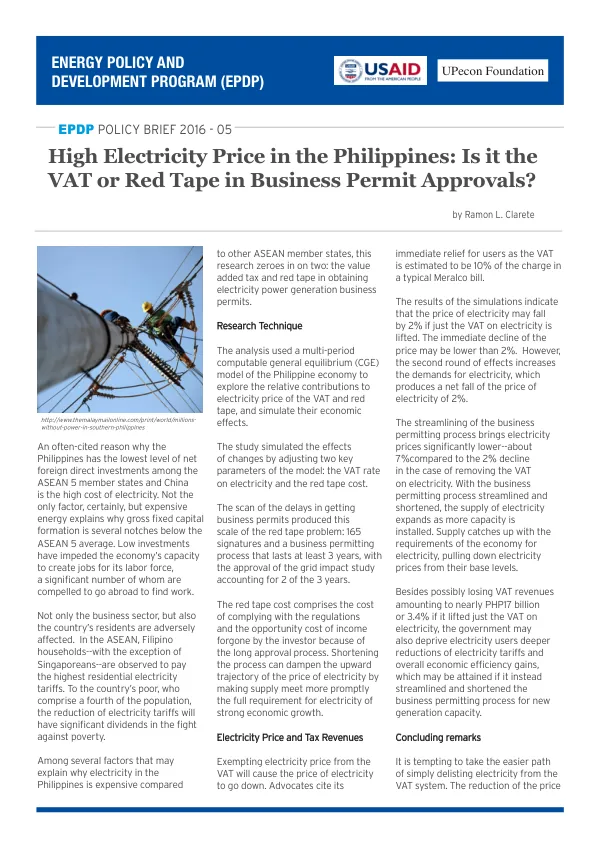
This high cost of electricity is a significant deterrent to investments, which in turn affects the economy's capacity to create jobs. The country's poor, who comprise a fourth of the population, are particularly affected by the high cost of electricity, which hinders their fight against poverty. The high cost of electricity in the Philippines is attributed to several factors, with the value-added tax (VAT) and red tape in business permit approvals being two of the most significant contributors. A study conducted by Ramon L. Clarete, using a multi-period computable general equilibrium (CGE) model, aimed to explore the relative impact of these two factors on electricity prices. The study simulated the effects of changes in the VAT rate on electricity and the cost of complying with regulations, which is known as the red tape cost. The results of the study indicate that the red tape cost has a more significant impact on electricity prices, with a 7% reduction in prices if the business permitting process is streamlined and shortened. In contrast, exempting electricity from the VAT would only lead to a 2% reduction in prices. The study also found that the red tape cost comprises the cost of complying with regulations and the opportunity cost of income forgone by investors due to the long approval process. The business permitting process for electricity power generation businesses is a significant contributor to the red tape problem, with a minimum of 165 signatures required and a process that takes at least 3 years to complete. The approval of the grid impact study accounts for 2 of the 3 years, reflecting the lack of coordination among agencies regulating the industry. The study recommends streamlining the business permitting process to reduce the red tape cost and increase the supply of electricity, which would lead to lower electricity prices. The study also highlights the importance of benchmarking with similar business processes in other countries to identify unnecessary delays and inefficiencies. For example, consultations with indigenous peoples on ancestral domains need to be done, and the duration and scope of these consultations should be agreed upon and incorporated into implementing regulations. The two-year grid impact study approval process is identified as the elephant in the red tape problem, reflecting the lack of coordination among agencies regulating the industry. The study concludes that cutting the red tape involved in obtaining electricity power generation business permits carries more leverage in undoing one of the important deterrents to investments and job creation in the Philippines. The study recommends streamlining the business permitting process to reduce the red tape cost and increase the supply of electricity, which would lead to lower electricity prices. This approach is considered more effective than simply delisting electricity from the VAT system, which would only provide temporary relief and may lead to deeper reductions in electricity tariffs and overall economic efficiency gains.