USAID
Welfare Effects of Higher-Blended Biodiesel on the Philippine Economy
The Biofuels Act of 2006 (RA 9367) was legislated to reduce the Philippines' dependence on imported fuels and protect public health and the environment.
2016 · 2 pages
Sign in to readA free account is required to download.
Abstract
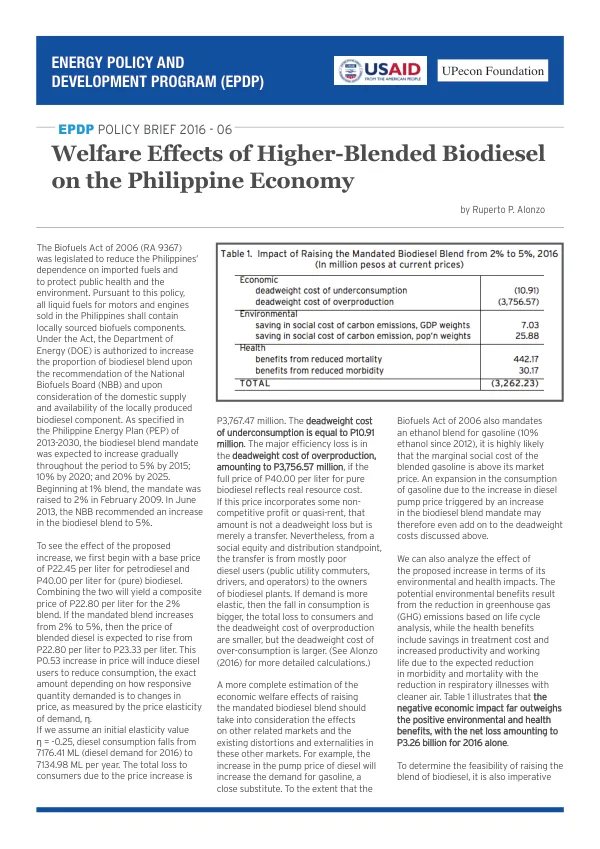
Pursuant to this policy, all liquid fuels for motors and engines sold in the Philippines shall contain locally sourced biofuels components. The Department of Energy (DOE) is authorized to increase the proportion of biodiesel blend upon the recommendation of the National Biofuels Board (NBB) and upon consideration of the domestic supply and availability of the locally produced biodiesel component. The biodiesel blend mandate was expected to increase gradually throughout the period to 5% by 2015; 10% by 2020; and 20% by 2025. Beginning at 1% blend, the mandate was raised to 2% in February 2009. In June 2013, the NBB recommended an increase in the biodiesel blend to 5%. To see the effect of the proposed increase, a base price of P22.45 per liter for petrodiesel and P40.00 per liter for pure biodiesel was used. Combining the two will yield a composite price of P22.80 per liter for the 2% blend. If the mandated blend increases from 2% to 5%, then the price of blended diesel is expected to rise from P22.80 per liter to P23.33 per liter. This P0.53 increase in price will induce diesel users to reduce consumption, the exact amount depending on how responsive quantity demanded is to changes in price, as measured by the price elasticity of demand, ƞ. If an initial elasticity value ƞ = -0.25 is assumed, diesel consumption falls from 7176.41 ML (diesel demand for 2016) to 7134.98 ML per year. The total loss to consumers due to the price increase is P3,767.47 million. The deadweight cost of underconsumption is equal to P10.91 million. The major efficiency loss is in the deadweight cost of overproduction, amounting to P3,756.57 million, if the full price of P40.00 per liter for pure biodiesel reflects real resource cost. A more complete estimation of the economic welfare effects of raising the mandated biodiesel blend should take into consideration the effects on other related markets and the existing distortions and externalities in these other markets. For example, the increase in the pump price of diesel will increase the demand for gasoline, a close substitute. The Biofuels Act of 2006 also mandates an ethanol blend for gasoline (10% ethanol since 2012), it is highly likely that the marginal social cost of the blended gasoline is above its market price. An expansion in the consumption of gasoline due to the increase in diesel pump price triggered by an increase in the biodiesel blend mandate may therefore even add on to the deadweight costs discussed above. The potential environmental benefits result from the reduction in greenhouse gas (GHG) emissions based on life cycle analysis, while the health benefits include savings in treatment cost and increased productivity and working life due to the expected reduction in morbidity and mortality with the reduction in respiratory illnesses with cleaner air. However, the negative economic impact far outweighs the positive environmental and health benefits, with the net loss amounting to P3.26 billion for 2016 alone.
Related documents
Documents in this collection
 2015
2015USAID DEC
Baseline Assessment: Management Effectiveness Tracking Tool (METT) for Philippines Biodiversity and Watersheds Improved for Stronger Economy and Ecosystem Resilience (B+WISER) Program
Open record 2021
2021USAID DEC