USAID
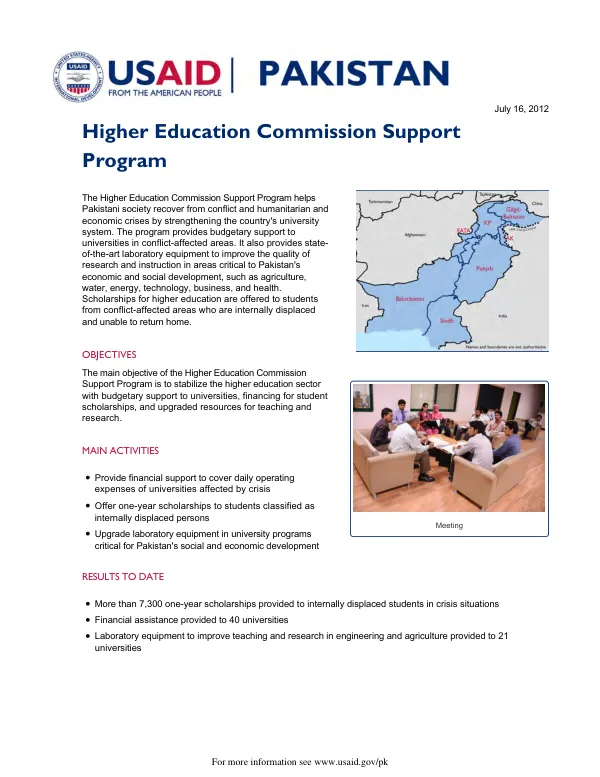
Higher Education Commission Support Program
The Higher Education Commission Support Program in Pakistan aims to strengthen the country's university system by providing budgetary support to universities in conflict-affected areas.
2012 · 1 pages
Sign in to readA free account is required to download.
Abstract
The program also offers state-of-the-art laboratory equipment to improve the quality of research and instruction in critical areas such as agriculture, water, energy, technology, business, and health. Scholarships for higher education are provided to students from conflict-affected areas who are internally displaced and unable to return home. The main objective of the program is to stabilize the higher education sector with budgetary support to universities, financing for student scholarships, and upgraded resources for teaching and research. The program's main activities include providing financial support to cover daily operating expenses of universities affected by crisis, offering one-year scholarships to internally displaced students, and upgrading laboratory equipment in university programs critical for Pakistan's social and economic development. Financial assistance has been provided to 40 universities, and more than 7,300 one-year scholarships have been offered to internally displaced students in crisis situations. Laboratory equipment has been provided to 21 universities to improve teaching and research in engineering and agriculture. The program's focus on upgrading laboratory equipment has been particularly beneficial in areas such as engineering and agriculture, where it has helped to improve the quality of research and instruction. The program's impact has been significant, with more than 7,300 students benefiting from scholarships and 40 universities receiving financial assistance. The provision of laboratory equipment has also helped to improve the quality of research and instruction in critical areas, contributing to Pakistan's social and economic development. The program's success has been achieved through a combination of financial support, scholarships, and upgraded resources for teaching and research. The Higher Education Commission Support Program has played a critical role in stabilizing the higher education sector in Pakistan, particularly in conflict-affected areas. By providing budgetary support, scholarships, and upgraded resources for teaching and research, the program has helped to improve the quality of education and contribute to Pakistan's social and economic development. The program's focus on critical areas such as agriculture, water, energy, technology, business, and health has been particularly beneficial, helping to address some of the country's most pressing development challenges.
Related documents