USAID
Pashto Pilot Midline Report
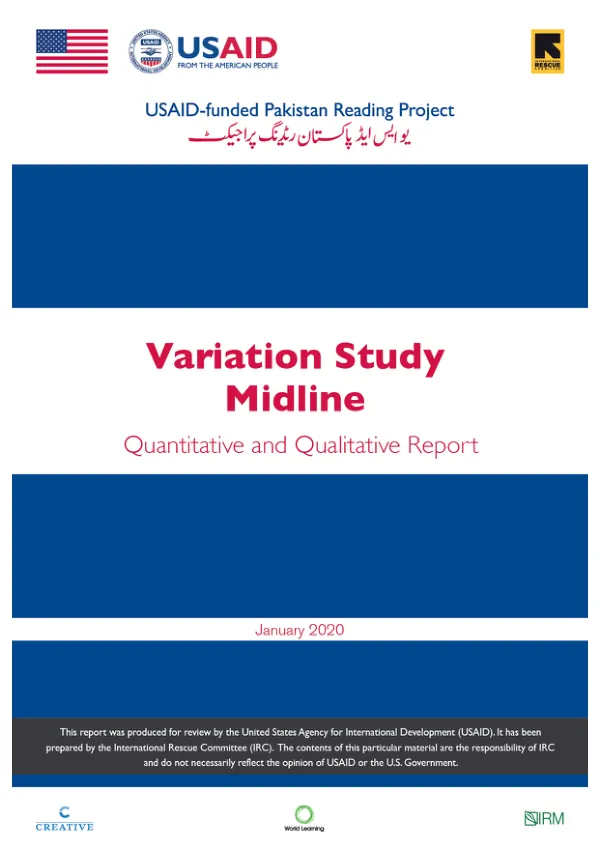
The USAID-funded Pakistan Reading Project (PRP) is working to improve students' reading skills in different regional languages, including Pashto, as well as the national language, Urdu.
2019 · 25 pages
Sign in to readA free account is required to download.
Abstract
In Khyber Pakhtunkhwa (KP), PRP has initiated a pilot project to enhance reading skills of students through intervention in 20 schools. The project's package includes Face to Face (F2F) trainings, Teacher In-charge Group (TIG) meetings, and provision of reading learning material along with partial school support visits. A quasi-experimental study is being conducted to assess the degree to which PRP is affecting students' reading skills and teachers' instructional practices in Pashto-medium schools. The current report presents midline results of this study, which aim to provide findings about students' reading skills and teachers' professional practices. The study used a quasi-experimental research design with treatment and control groups and baseline, midline, and end-line data. From the PRP-funded Pashto-medium schools, 16 schools were randomly selected to observe the impact of the project intervention. In comparison, 16 non-intervention (control) schools that matched the characteristics of the intervention schools were selected. Both grade 1 and grade 2 students were assessed in intervention and non-intervention schools, but only grade 1 students were taught by trained teachers in treatment schools. Teachers' classroom teaching was also observed. The results of the midline study indicate that students in intervention schools showed improvement in mean scores in all assessed tasks except orientation to print. The mean score for Oral Reading Fluency (ORF) increased by 9.3 points for grade 1 students. Additionally, a decrease of 18.2% in zero scorers was observed during the midline for grade 1 intervention students. However, the mean score of ORF recorded for grade 1 is still below the grade level performance standards, recorded as 17 Correct Words Per Minute (CWPM). Regarding teachers, it was observed that on average, teachers are at emerging levels of competence and will need further support to become proficient. There was no statistically significant difference in the instructional practices of teachers in intervention and control schools, although a large effect size was observed for "teaching reading and writing" competency, a medium effect size for "reading book preparation with lesson plan objective" and "teaching methods and resources," and a low effect size in two teaching competencies. The study also discusses the limitations and threats to validity, and provides recommendations for researchers and practitioners. The findings of this study will inform the development of effective interventions to improve reading skills and instructional practices in Pashto-medium schools. The study was conducted in 32 Pashto-medium schools, with 938 students (480 intervention and 451 control) and 53 teachers (26 intervention and 27 control) assessed. The data was collected using Early Grade Reading Assessment (EGRA) and Teacher Classroom Observation (TCO) tools during the month of February and March 2019. The results of the study indicate that the intervention had a positive impact on students' reading skills, with improvements observed in mean scores in all assessed tasks except orientation to print. The study also highlights the need for further support for teachers to become proficient in instructional practices. The study's findings will inform the development of effective interventions to improve reading skills and instructional practices in Pashto-medium schools. The study's results will also inform the development of effective teacher training programs for Pashto-medium schools. The study's methodology involved a quasi-experimental research design with treatment and control groups and baseline, midline, and end-line data. The study used a random sampling method to select 16 schools for the intervention group and 16 schools for the control group. The study also used a stratified sampling method to select students and teachers for the study. The study's findings will inform the development of effective interventions to improve reading skills and instructional practices in Pashto-medium schools. The study
Related documents