AMERICAN ASSOCIATION OF COMMUNITY COLLEGES
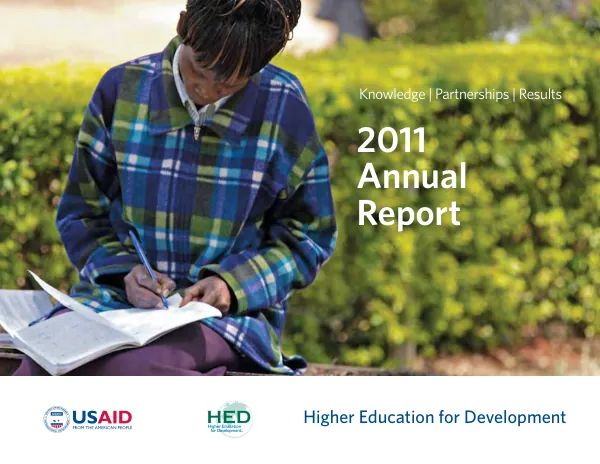
Higher Education for Development 2011 Annual Report
Higher Education for Development (HED) diversifies and expands the engagement of higher education in international development, focusing on human capital development and institutional strengthening necessary for economic growth and social advancement.
2011 · 24 pages
Sign in to readA free account is required to download.
Abstract
HED was founded in 1992 by the six major U.S. higher education associations, including the American Association of Community Colleges, the American Association of State Colleges and Universities, the American Council on Education, the Association of American Universities, the Association of Public and Land-grant Universities, and the National Association of Independent Colleges and Universities. In FY2011, HED supported USAID priority objectives in 35 countries and provided the expertise of faculty and researchers from 58 higher education institutions. HED initiated 17 new partnerships in FY2011, bringing the total number of active partnerships to 75 for the year. These partnerships focus on various areas, including environmental concerns, workforce development, civil society, and more. HED's development portfolio has both depth and breadth, with programs such as trial advocacy training in Mexico, expanding small business development centers in Latin America and the Caribbean, building capacity through quality teacher preparation in Kenya, and addressing food security needs in South Sudan. The Africa–U.S. Higher Education Initiative is a collaborative effort among multiple organizations and higher education associations designed to strengthen sub-Saharan Africa's capacity to address development challenges. The initiative was spearheaded by the Association of Public and Land-grant Universities and has resulted in 11 partnerships that are changing the landscape of higher education in Africa with new academic programs and curricula, improved faculty and staff capacity, centers of excellence, applied research, and community engagement. Each partnership has in place a well-structured, five-year strategic plan to develop human and institutional capacity to support national development goals. The U.S.–Middle East University Partnerships Program has greatly influenced curriculum and course delivery in the Middle East, in areas including civic education, journalism, economic growth, and workforce development. The program also continues to support women's education, a key development priority. Since 2003, the program has involved 23 U.S.–Middle East university partnerships in 13 countries. During FY2011, active partnerships focused on business administration, women's studies, and journalism in the United Arab Emirates and Qatar. An innovative joint global media course designed by the University of Louisiana at Lafayette and Qatar University utilized information and communication technology to bridge cultural and technical gaps that benefited both partners, as well as their communities. HED's partnerships promote social and economic mobility through education. Whether within the walls of academia or in villages across nations, education propels change in the environment, in the economy, and in the very way people think about problems—and how they arrive at solutions. The knowledge-sharing practices established through these collaborations reinforce what USAID, the U.S. Department of State, and the nation's six major higher education associations believe: Education creates long-term, sustainable, positive socioeconomic change. HED is proud to be an engine of that change.