MALARIA CONSORTIUM
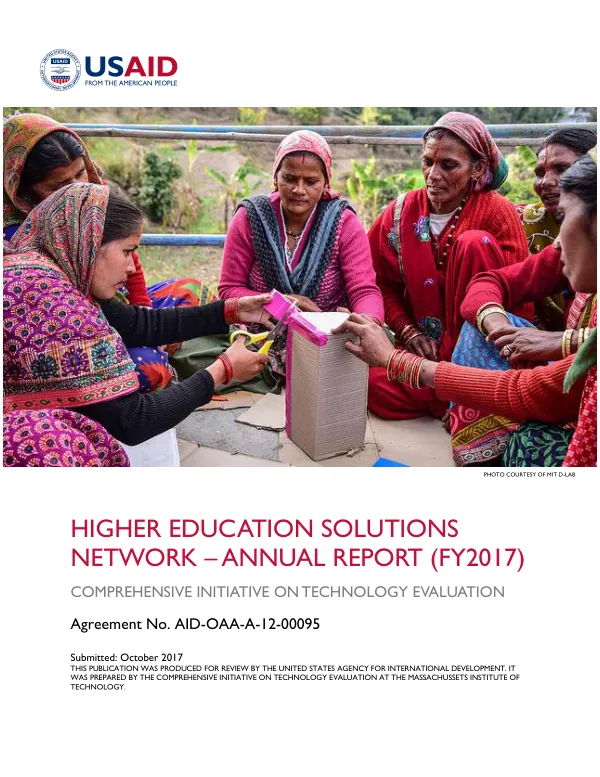
Higher Education Solutions Network – Bi-Annual Report (FY 2015)
The Comprehensive Initiative on Technology Evaluation (CITE) is a network of Massachusetts Institute of Technology (MIT) faculty, staff, and students with expertise in technology design and testing, systems engineering, supply chains, community ethnography, institutional and public policy analysis, market systems analysis, and regional economics.
2015 · 23 pages
Sign in to readA free account is required to download.
Abstract
CITE's goal is to develop a rigorous product evaluation method that will help development organizations make educated product deployment decisions in emerging market economies. During the first half of CITE's third year, the initiative reported milestones and achievements related to impact within MIT, contribution to USAID through the Global Development Lab and Higher Education Solutions Network, and global partnership. A major milestone was the release of the Solar Lantern evaluation report, which was followed by a panel event to raise awareness of the report's findings. The report's results have been read by over 2,500 individuals, and feedback from partners Mercy Corp and Solar Sister confirmed the value of evidence-based decision making in development. CITE has also increased productivity during year 3, with four evaluation projects underway in two countries, compared to one in each of the first two years. Three of the four evaluation projects included an initial field trip to scope out the project, and all three of these field visits have been completed. A single field trip was required as part of the fourth evaluation, and this has also been completed. As part of the initial water test kit evaluation field visit, water quality results have already been provided to each of the 234 participants in the study. Development of partnerships has been a key achievement during this reporting period. CITE has continued to build a learning community at MIT, extending its outreach to the Media Lab, Office of Digital Learning, International Development House, and the Tata Center for Technology and Design. Collaboration with local NGOs, universities, global organizations, and USAID has been instrumental in shaping the CITE year 3 evaluations and providing support in the field. CITE's partnership with Prof Ankur Sarin and Indian Institute of Management -Ahmedabad has evolved significantly, with Prof Sarin and his students collaborating fully as research partners in the Water Test Kit evaluation. CITE course development has also continued as part of year 3 activities. Significant achievements include the development of a new initiative with the Public Service Center and International Development House at MIT to create new teaching materials for undergraduates through a summer partnership with an MIT alumnus. A semester-long seminar is currently underway to allow participating undergraduate students to cultivate the skills and gather the information necessary to write a development-focused teaching case. Additionally, CITE's edX Postdoctoral Associate Fellow has developed a framework and content for a new edX course on the evaluation of products designed for the developing world to be aimed at professionals. The annual work plan for the third year of the initiative was developed to guide project activities in line with CITE's overarching goal of increasing the impact and cost-effectiveness of products designed for people living in poverty. CITE proposed a suite of technology evaluations for year 3 based on an extensive survey of USAID and partner organizations. The evaluations focused on a range of products, including solar lanterns, water filters, and water test kits, with the aim of developing and implementing a product evaluation methodology that will help development organizations make informed decisions about product deployment.