USAID
International Innovation Corps (IIC) Project Summaries
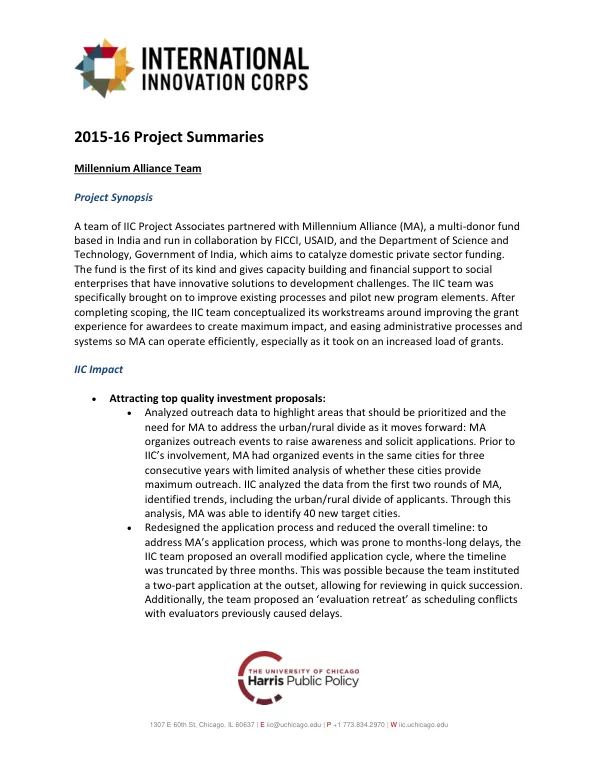
The Millennium Alliance Team partnered with the International Innovation Corps (IIC) to improve existing processes and pilot new program elements.
2015 · 29 pages
Sign in to readA free account is required to download.
Abstract
The IIC team conceptualized its workstreams around improving the grant experience for awardees to create maximum impact and easing administrative processes and systems for the Millennium Alliance (MA). MA is a multi-donor fund based in India, run in collaboration by FICCI, USAID, and the Department of Science and Technology, Government of India. The fund aims to catalyze domestic private sector funding by providing capacity building and financial support to social enterprises with innovative solutions to development challenges. The IIC team analyzed outreach data to highlight areas that should be prioritized and the need for MA to address the urban/rural divide. This analysis identified 40 new target cities, and the team redesigned the application process to reduce the overall timeline by three months. The team also developed a new two-part evaluation format to ensure all critical evaluation points were covered, and a needs assessment tool to assess the capacity needs of awardees. The IIC team designed a comprehensive M&E template to enable MA to monitor the status of awardees and project goals. They also created a framework for a grant management dashboard to facilitate clear and structured communication between awardees, portfolio managers, and partners. Additionally, the team institutionalized workshops that support awardees long-term, including a workshop on Theory of Change that helped entrepreneurs develop long-term plans and understand the components and requirements of setting up a successful enterprise. The CCE Rajasthan Team partnered with the Rajasthan Council for Secondary Education (RCSE) to support reforms taking place across the state to improve the quality of education. The team worked in the areas of the State Initiative for Quality Education (SIQE), community engagement, staffing, and additional projects. Within SIQE, the team assisted with streamlining the monitoring mechanism for Principal and Key Resource Principal Trainings, facilitated communication between RCSE and Bodh, and promoted SIQE adoption on the ground by improving the quality of videoconferences and collating a comprehensive FAQs document. The team also worked within a broad ecosystem of stakeholders to alter RCSE's attitude towards School Development and Management Committees (SDMCs) and parents. They focused on the dissemination, training, and monitoring of standardized SDMC guidelines, which will be used to train and educate 4,400 SDMC members from 1,340 schools. The team worked in the staffing work stream to facilitate a historically low staff vacancy of less than 16% in the Secondary Education Department by streamlining the process of collecting and using staffing-related data. The IIC team's work in Rajasthan led to significant outcomes, including a decline in teacher vacancies from 40-50% to less than 16%, and the successful implementation of a transformative Teacher Transfer Policy. The team's efforts also supported educational reform in Rajasthan by providing new perspectives, conducting primary and secondary research on existing practices, and engaging hands-on in program implementation.
Related documents