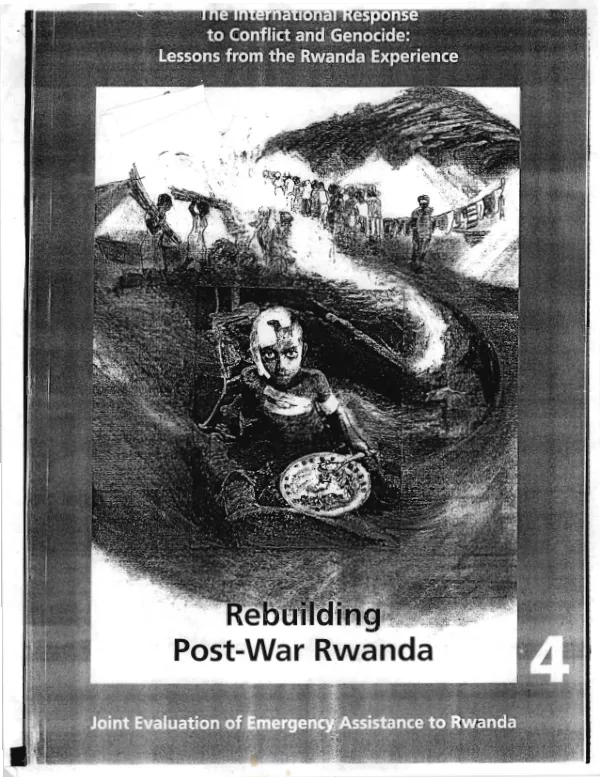
STEERING COMMITTEE OF THE JOINT EVALUATION OF EMERGENCY ASSISTANCE TO RWANDA
Historical perspective : some explanatory factors
This study describes the historical background to developments in Rwanda that culminated in the genocide that began in April 1994.
Sellstrom, Tor; Wohlgemuth, Lennart · 1996
Sign in to readA free account is required to download.
Abstract
The subject is treated in chronological order, covering: the pre-colonial period (pre-1916), the colonial period and independence (1916-1989), the development of the present crisis (1990-94), and the events of April 1994 and their aftermath. An initial chapter presents the country setting, while appendices describe Rwanda"s place in the region and the foreign arming of the parties to the present conflict. An annotated bibliography is included. The study concludes that the tragedy in Rwanda was the result of a complex of cumulative and interacting historical events and actors. The following are the most important of these: (1) the build-up of indigenous social and political structures, particularly during the second half of the 19th century when the Tutsi king Rwabugiri began the polarization of Tutsi and Hutu and the politicization of ethnicity; (2) the German and Belgian colonial policy of indirect rule, favoring the strengthening of Tutsi hegemony and resulting in a political and administrative monopoly in the hands of aristocratic Tutsi overlords of the Nyiginya clan from the 1920s; (3) Belgium"s abrupt change in 1959-61 when -- under the influence of the general decolonization process, the build-up towards independence in the Congo (Zaire), and a belated attempt to redress past injustices -- the colonial administration (and the Catholic Church) shifted support from the minority Tutsi to the majority Hutu, leading to exile of tens of thousands of Tutsis; (4) the development of Rwandese society over centuries into a remarkably organized state, with a political culture of centralized social control; (5) increasing intra-Hutu tensions, mainly between groups from the northern Gisenyi and Ruhengeri regions and those from the rest of the country during the First and Second Republics (1962-1990); (6) the economic slump of the late 1980s and the effects of the government-donor structural adjustment program of 1990-92, which introduced more stress and instability; (7) the refugee crisis, which started in 1959 and became a constant political and social problem as exiled Tutsis became increasingly militant; (8) the fact that those responsible for the repeated mass killings in Rwanda since 1959 have never been brought to justice, and the resultant culture of fear, a legacy of the division between privileged Tutsi and underprivileged Hutu during the colonial period; and (9) other developments in the Great Lakes region (Rwanda, eastern Zaire, northwestern Tanzania, and Burundi) taking the form of, among other things, crossborder flows of refugees, weapons, ideas, and fears. All these factors, sometimes fueled and sometimes constrained by interventions of the international community, led to the manipulation of ethnicity in the 1990s, which in turn led to genocide.