USAID DEC
HOMBRES Y MUJERES AL SERVICIO DE LA DEMOCRACIA: Observadores Internacionales en Colombia
Sign inMISIÓN DE OBSERVACIÓN ELECTORAL
HOMBRES Y MUJERES AL SERVICIO DE LA DEMOCRACIA: Observadores Internacionales en Colombia
The Misión de Observación Electoral (MOE) Internacional has been observing elections in Colombia since 2006.
2014 · 12 pages
Sign in to readA free account is required to download.
Abstract
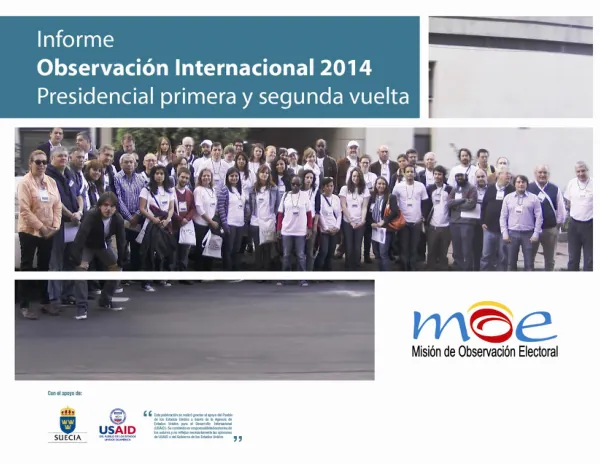
The MOE Internacional is composed of delegates from various countries with a presence in Colombia who voluntarily conduct observation in the country. In 2010, this component was expanded to include not only foreign observers but also Colombians who monitored the electoral process in Colombian consulates and embassies abroad. International observation is a crucial activity for improving the electoral process and democracy in a country. Foreign citizens and electoral professionals contribute to the development of the democratic system where observation takes place, bringing another perspective, comparing it with their original system, and presenting recommendations to optimize electoral processes. International observers and national observers act on behalf of citizens and democracy, putting their eyes and ears at the service of electoral guarantees to report facts and/or possible irregularities during elections. The MOE Internacional has a code of ethics that considers and complies with the Declaration of Global Principles for Election Observation by the Non-Partisan Civil Society and the Code of Conduct for Non-Partisan Observers signed by the MOE and the Lima Agreement in the United Nations on April 3, 2012, and ratified at the First Implementation Meeting of the Declaration of Global Principles held in Beirut in April 2013. For the 2014 national elections, the MOE Internacional renewed past experiences and expanded its network of observers. For the Congressional elections, the MOE Internacional mobilized more than 120 observers, and for the Presidential elections, 269 (159 in the first round and 110 in the second round). This expansion was possible thanks to citizens and diplomatic bodies aware of the protection of democracy and alliances with international organizations that supported the MOE's activities in Colombia and abroad. The MOE Internacional has a presence in Colombia, with observers from various countries, including Argentina, Venezuela, and Brazil. In Bogotá, observers received training from the Coordinator of Electoral Quality and regional coordinators of the MOE. The training included a general presentation of the MOE's activities and principles, a panorama of the Colombian electoral context, and an explanation of the electoral day development and electoral legislation. The MOE Internacional organizes international observation itinerantly in Bogotá and the regions. In Bogotá, five routes were programmed (three for the first round and two for the second round), each observing four polling stations in different areas of the capital. In the regions, observers accompanied the MOE coordinator in the locality to observe several polling stations. During the electoral process, the MOE Internacional highlighted several reports and information provided through the accompaniment provided by international observers. Some of the most important observations include: The lack of judges of the vote in the polling stations, with 57% (first round) and 50% (second round) of observers noting that the six judges of the vote were not present at the time of the opening of the polling station. The presence of too many people in the polling stations, without identification, creating confusion among participants (electoral witnesses, judges of the vote, officials of the Electoral Registry, members of the justice table: officials of the Prosecutor's Office, Attorney General's Office, and Ombudsman's Office). The difficulty in distinguishing the justice table and its members, and confirming the presence of public officials, with an average of almost 25% of observers unable to do so. The lack of secrecy in voting, with 34% (first round) and 40% (second round) of observers thinking that in the observed cubicle, it was not possible to vote in secret. The majority of polling stations do not allow the urn to be placed on top, making it difficult for voters. The urns were not well closed due to a poor-quality adhesive tape. The biometric systems were not installed in the polling stations, as the Electoral Registry did not report the locations where they were installed.