CHF
HOSTING SUPPORT - AN OVERLOOKED HUMANITARIAN SHELTER SOLUTION
Humanitarian shelter solutions often overlook the role of hosting by family and friends, who provide spontaneous sheltering to disaster or crisis survivors.
2012 · 2 pages
Sign in to readA free account is required to download.
Abstract
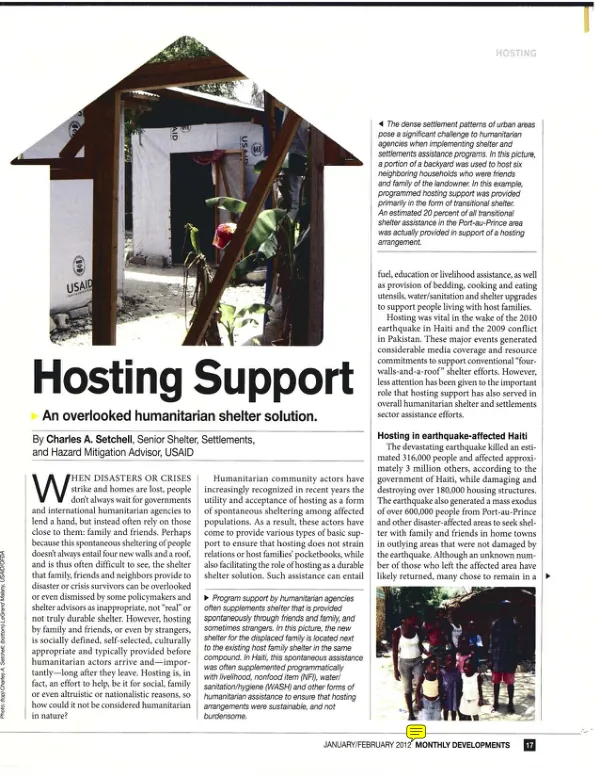
This form of sheltering is socially defined, self-selected, culturally appropriate, and typically provided before humanitarian actors arrive and long after they leave. Hosting is an effort to help, driven by social, family, or altruistic reasons, and is therefore considered humanitarian in nature. Humanitarian community actors have increasingly recognized the utility and acceptance of hosting as a form of spontaneous sheltering among affected populations. As a result, these actors have come to provide various types of basic support to ensure that hosting does not strain relations or host families' pocketbooks. This support can include program assistance, such as livelihood, nonfood item, water/sanitation/hygiene, and other forms of humanitarian assistance. In Haiti, hosting support was often supplemented programmatically with assistance to ensure that hosting arrangements were sustainable and not burdensome. An estimated 20 percent of all transitional shelter assistance in the Port-au-Prince area was actually provided in support of a hosting arrangement. In the wake of the 2010 earthquake, hosting was vital, with nearly 18,500 hosting arrangements evolving into permanent housing solutions for those families. USAID's Office of U.S. Foreign Disaster Assistance (USAID/OFDA) approved grants to three implementing partners to engage in hosting support after the 2010 earthquake in Haiti. The three NGOs eventually combined to support 26,523 hosting arrangements, with an estimated 95 percent of hosting families being either related to or friends of the hosted families. Assistance to support hosting arrangements ranged from $250 to $800 per hosting arrangement. In conflict-affected Pakistan, hosting support was also crucial, with nearly 90 percent of displaced individuals being hosted by family and friends. Direct support to host families often included programs to alleviate crowded conditions, mobile medical clinics, voucher programs, and cash-for-work, cash grant, and rental assistance programs. Nearly two-thirds of USAID's combined assistance for Pakistan's conflict-affected individuals directly benefited IDPs and host families in KPK. The willingness of people to help those in need by creating hosting arrangements is a common thread in both Haiti and Pakistan. This activity occurred in both post-disaster and post-conflict settings, be they in urban or rural areas. However, supporting this form of sheltering can sustain it, and humanitarian actors should support hosting arrangements where possible and feasible using a range of measures. The humanitarian community has come to recognize the importance of hosting as a form of sheltering, and has taken steps to support it. However, hosting is not a universal panacea and is best implemented when family and friends are involved. By supporting hosting arrangements, humanitarian actors can help sustain this form of sheltering and provide critical assistance to those in need.
Related documents