USAID DEC
The Role of Zinc and Iron-Folic Acid Supplementation on Early Child Temperament and Eating Behaviors in Rural Nepal: A Randomized Controlled Trial
Sign inCORNELL UNIVARSITY INTERNATIONAL
The Role of Zinc and Iron-Folic Acid Supplementation on Early Child Temperament and Eating Behaviors in Rural Nepal: A Randomized Controlled Trial
Child temperament and eating behaviors play a crucial role in nutrient intake, ultimately affecting child growth and later outcomes in adulthood.
2015 · 15 pages
Sign in to readA free account is required to download.
Abstract
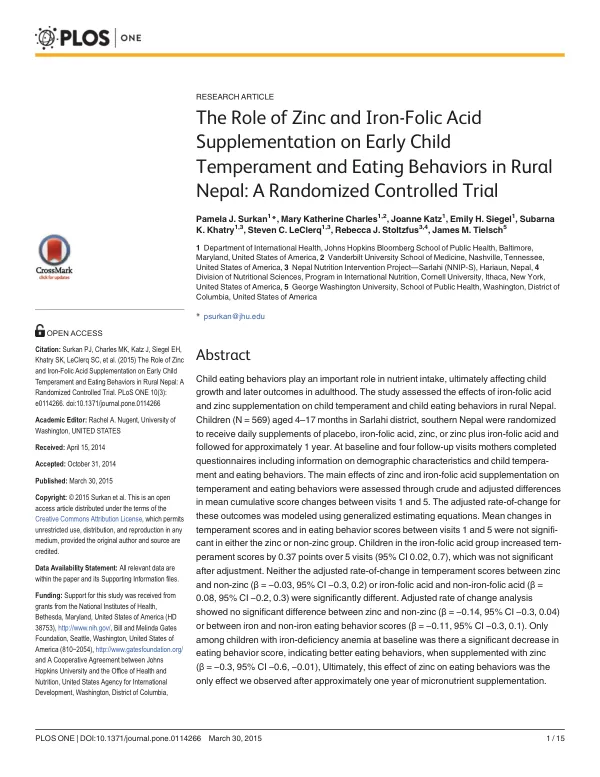
In rural Nepal, iron and zinc deficiencies are a significant problem, with an estimated 43% of children below the age of two suffering from iron-deficiency anemia and 16% having serum zinc levels under 9.2 μmols/L. A randomized controlled trial was conducted to assess the effects of iron-folic acid and zinc supplementation on child temperament and eating behaviors in rural Nepal. The study involved 569 children aged 4-17 months in Sarlahi district, southern Nepal, who were randomized to receive daily supplements of placebo, iron-folic acid, zinc, or zinc plus iron-folic acid. The main effects of zinc and iron-folic acid supplementation on temperament and eating behaviors were assessed through crude and adjusted differences in mean cumulative score changes between visits 1 and 5. The adjusted rate-of-change for these outcomes was modeled using generalized estimating equations. The results showed that children in the iron-folic acid group increased temperament scores by 0.37 points over 5 visits, which was not significant after adjustment. Neither the adjusted rate-of-change in temperament scores between zinc and non-zinc nor between iron and non-iron eating behavior scores were significantly different. However, among children with iron-deficiency anemia at baseline, there was a significant decrease in eating behavior score when supplemented with zinc. The study found that zinc supplementation had a significant effect on eating behaviors among children with iron-deficiency anemia, indicating better eating behaviors. This effect of zinc on eating behaviors was the only effect observed after approximately one year of micronutrient supplementation. The study suggests that zinc supplementation may have a positive impact on eating behaviors in children with iron-deficiency anemia, which could have long-term implications for child growth and development. The Nepal Nutrition Intervention Project-Sarlahi (NNIPS-4) was a micronutrient supplementation trial that assessed the effect of iron-folic acid and zinc on mortality. The study was conducted in 426 randomized geographic clusters within 30 Village Development Committees (VDCs) using a cluster randomized 2×2 factorial design. The study was conducted in the rural southern district of Sarlahi, Nepal, within the Ishwarpur VDC, which contained 23 geographic clusters. Participants were eligible for participation if they lived in Ishwarpur between January 7 and April 6, 2002, and were between 4 and 17 months of age. A total of 613 eligible infants were identified through a population-based census conducted between December 2000 and March 2001. Only 44 (7%) of the eligible infants did not participate, either because they were not located or their caregivers did not provide consent. The remaining 569 infants were randomized to the 4 study arms: placebo (N = 152), iron-folic acid (N = 129), zinc (N = 126), and zinc plus iron-folic acid (N = 162). Data were collected through questionnaires administered at baseline and during four follow-up visits at approximately three-month intervals. The duration of participation was approximately one year. During baseline and follow-up visits, demographic and developmental data were collected in addition to temperament and child eating behavior outcomes. Baseline demographic data included infant age in months, gender, caste, and other relevant information. The study was approved by the Johns Hopkins University Committee on Human Subjects Research and the Nepal Health Research Council. The authors confirm that this sub-study as well as all ongoing and related trials, the main trial, are registered at clinicaltrials.gov (NCT00109551). The study sponsors did not have a role in study design, data collection, analysis, interpretation, or the writing of this report.
Related documents
Documents in this collection
 2017
2017USAID DEC
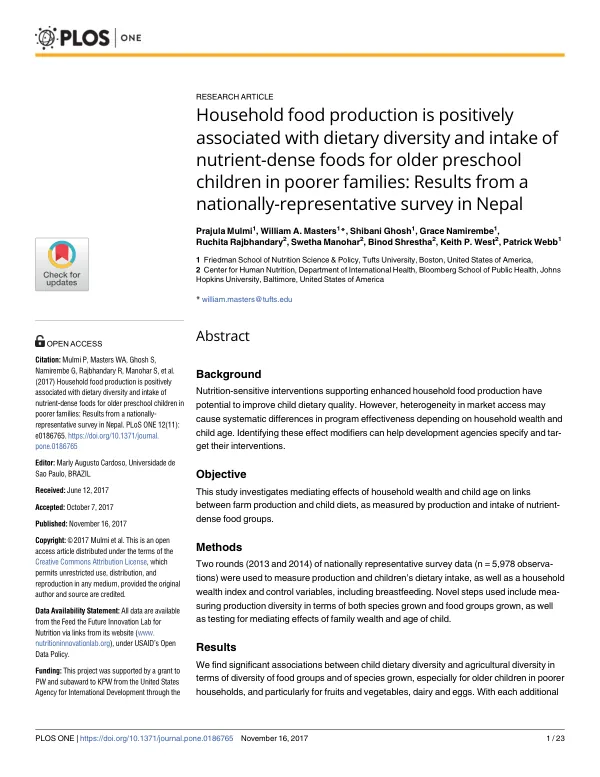
Household food production is positively associated with dietary diversity and intake of nutrient-dense foods for older preschool children in poorer families: Results from a nationally-representative survey in Nepal
Open record 2013
2013USAID DEC