USAID DEC
Household Resilience Strengthened By Market Systems: Cartoon #3 in the Market Systems Resilience Learning Series
Sign inDAI
Household Resilience Strengthened By Market Systems: Cartoon #3 in the Market Systems Resilience Learning Series
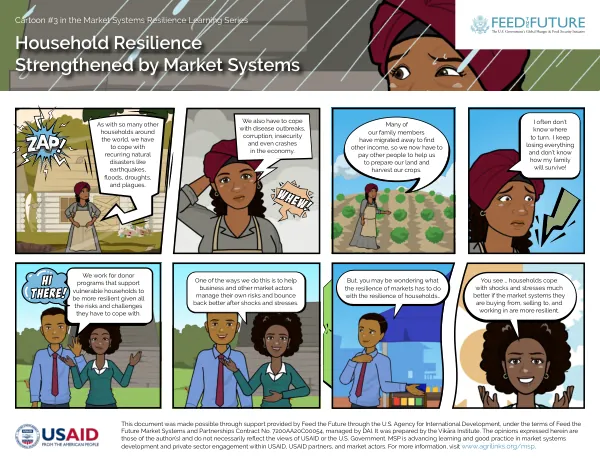
Household Resilience Strengthened by Market Systems Households around the world face recurring natural disasters such as earthquakes, floods, droughts, and plagues, as well as disease outbreaks, corruption, insecurity, and economic crashes.
2023 · 16 pages
Sign in to readA free account is required to download.
Abstract
Many family members have migrated away to find other income, leaving households to pay others to prepare their land and harvest their crops. This can be overwhelming, and households often struggle to cope with the risks and challenges they face. The resilience of markets plays a crucial role in helping households to be more resilient. When market systems are more resilient, they can provide households with essential products and services that help them to prevent, manage, or avoid losing too much or struggling too much during difficult times. Businesses can prioritize selling essential products and promoting them to their household customers, such as stronger, higher-quality eco-bricks and other products to build better homes, workspaces, and animal enclosures. Households become more resilient when markets start getting essential products and services to them. However, businesses need help understanding how it is good for business to continually improve the products they sell and the services they provide to household customers. This means providing a range of quality products and services that are affordable and accessible to many low-income and rural households. For example, households can buy health and crop insurance before their family gets sick or their animals or crops struggle when the weather gets bad, so they can get financial support quickly when something goes wrong. Businesses need to connect to and engage with households as valued customers. Some things are critical to households during a shock or stress that businesses need to prioritize, such as food, temporary shelter, and healthcare. This means that businesses need to find ways to understand what their household customers need, how it can be distributed to them, and what information they will need to use it well. Businesses can give their household customers information about challenging things that might be expected and how to plan for them. Markets help households to access and generate cash to manage risks and stresses better. When essential services are delivered in different places and ways, vulnerable households can more easily access health, energy, and other services during a crisis. Households can sell crops, livestock, or things they make to businesses, work for a business to earn money, or take a loan from a bank or savings group to buy what they need. Markets help households to build supportive networks and manage risk by planning for the long term. As market systems grow, they become better and better at employing or buying from more households. Businesses need to form good connections and relationships with households, and households need to be able to feel that businesses are hiring and buying fairly. If market systems become more resilient, then the households relying on them for income, jobs, and what they need to buy will also be more resilient. Markets also help to build trusted and supportive commercial networks between households and retail stores selling goods to them, and buyers buying produce and other products from them.