USAID DEC
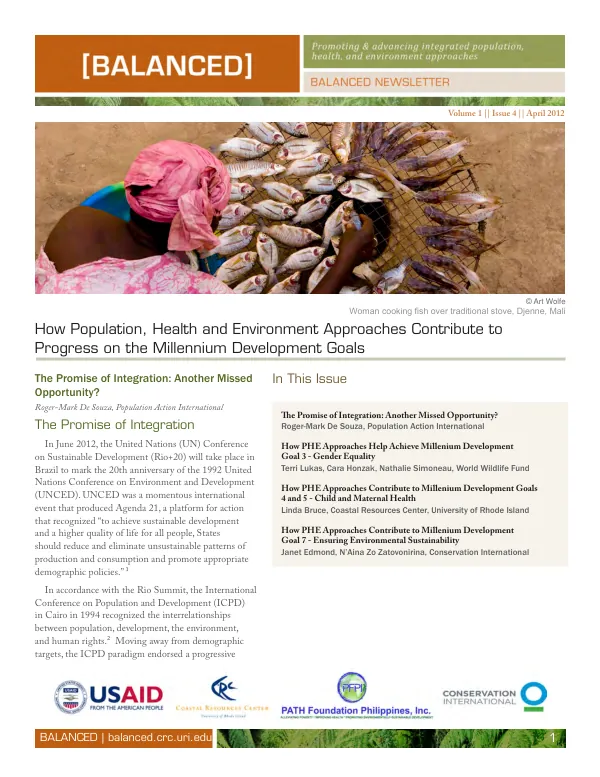
How Population, Health and Environment Approaches Contribute to Progress on the Millennium Development Goals
Sign inCOASTAL RESOURCES CENTER OF THE UNIVERSITY OF RHODE ISLAND
How Population, Health and Environment Approaches Contribute to Progress on the Millennium Development Goals
The Millennium Development Goals (MDGs) were adopted by world leaders in 2000 to provide benchmarks for tackling extreme poverty in its many forms.
2012 · 20 pages
Sign in to readA free account is required to download.
Abstract
The MDGs include a range of development priorities such as eradicating hunger, improving education, promoting gender equality, reducing child mortality, improving maternal health, combating HIV/AIDS, malaria, and other diseases, ensuring environmental sustainability, and implementing policies to ensure global partnerships for equitable development. The MDGs explicitly discuss the interrelationship between population, sustained economic growth, and the environment, but do not directly address the relevance of demographic factors for achieving these global objectives. The MDGs include eight goals with 18 targets and a series of measurable indicators for each target. Goal 1 aims to eradicate extreme poverty and hunger, while Goal 2 focuses on achieving universal primary education. Goal 3 seeks to promote gender equality and empower women, while Goal 4 targets the reduction of child mortality rates. Goal 5 aims to improve maternal health, and Goal 6 focuses on combating HIV/AIDS, malaria, and other diseases. Goal 7 seeks to ensure environmental sustainability, and Goal 8 targets the development of a global partnership for development. The MDGs have been criticized for not adequately addressing the interrelationship between population, economic growth, and environmental sustainability. The promotion of greener economies, which addresses economic growth and technological progress, has received increasing attention in recent years. However, the role of population dynamics has been largely neglected by policymakers, who believe that the population problem has already been solved or that addressing it would infringe on fundamental human rights. The UN Population Fund (UNFPA) has noted that the population problem has not been adequately addressed, and that the focus on greener economies has not considered the impact of population growth on environmental sustainability. The Civil Society Declaration of the 64th DPI/NGO Conference, held in late 2011, reaffirmed the importance of PHE integration in strengthening the resilience of communities to environmental and economic shocks. The MDGs have been criticized for not adequately addressing the interrelationship between population, economic growth, and environmental sustainability. The promotion of greener economies has received increasing attention, but the role of population dynamics has been largely neglected. The UNFPA has noted that the population problem has not been adequately addressed, and that the focus on greener economies has not considered the impact of population growth on environmental sustainability. The MDGs include a range of development priorities, including eradicating hunger, improving education, promoting gender equality, reducing child mortality, improving maternal health, combating HIV/AIDS, malaria, and other diseases, ensuring environmental sustainability, and implementing policies to ensure global partnerships for equitable development. The MDGs explicitly discuss the interrelationship between population, sustained economic growth, and the environment, but do not directly address the relevance of demographic factors for achieving these global objectives.
Related documents