USAID
How to Use Cost-Benefit Analysis throughout the Program Cycle
Cost-benefit analysis is a valuable tool that can be applied throughout the program cycle to inform decision-making and ensure the effective allocation of resources.
2014 · 1 pages
Sign in to readA free account is required to download.
Abstract
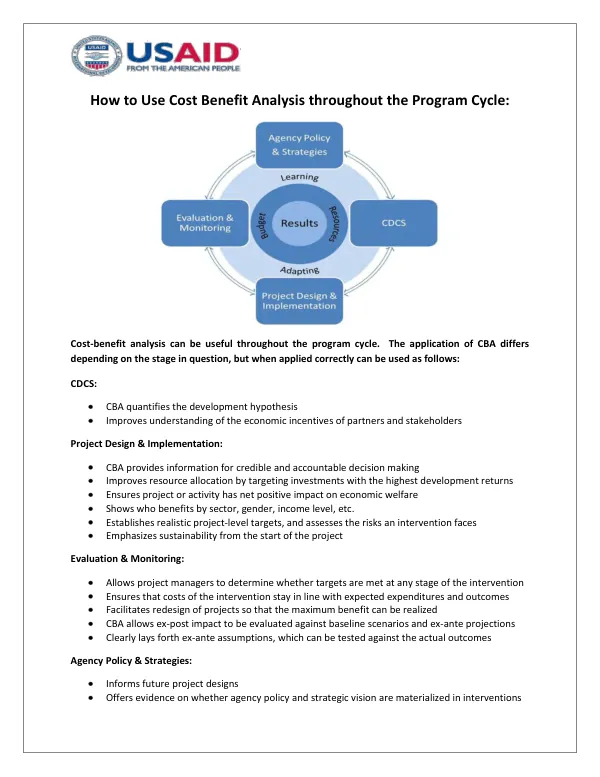
At the Country Development Cooperation Strategy (CDCS) stage, cost-benefit analysis quantifies the development hypothesis, providing a clear understanding of the economic incentives of partners and stakeholders. This understanding is essential for developing a comprehensive and effective development strategy. During project design and implementation, cost-benefit analysis plays a crucial role in providing credible and accountable decision-making information. It improves resource allocation by targeting investments with the highest development returns, ensuring that projects or activities have a net positive impact on economic welfare. Cost-benefit analysis also shows who benefits by sector, gender, income level, and other factors, allowing for more targeted and effective interventions. Furthermore, it establishes realistic project-level targets and assesses the risks an intervention faces, emphasizing sustainability from the start of the project. In the evaluation and monitoring phase, cost-benefit analysis allows project managers to determine whether targets are met at any stage of the intervention. It ensures that costs of the intervention stay in line with expected expenditures and outcomes, facilitating the redesign of projects to maximize benefits. Cost-benefit analysis also enables the evaluation of ex-post impact against baseline scenarios and ex-ante projections, providing valuable insights for future project designs. Additionally, it clearly lays forth ex-ante assumptions, which can be tested against actual outcomes. At the agency policy and strategies level, cost-benefit analysis informs future project designs and offers evidence on whether agency policy and strategic vision are materialized in interventions. It provides a framework for evaluating the effectiveness of policy and strategic decisions, allowing for adjustments and improvements to be made. By applying cost-benefit analysis throughout the program cycle, development agencies can ensure that their interventions are effective, efficient, and sustainable, ultimately contributing to the achievement of development goals.
Related documents