USAID
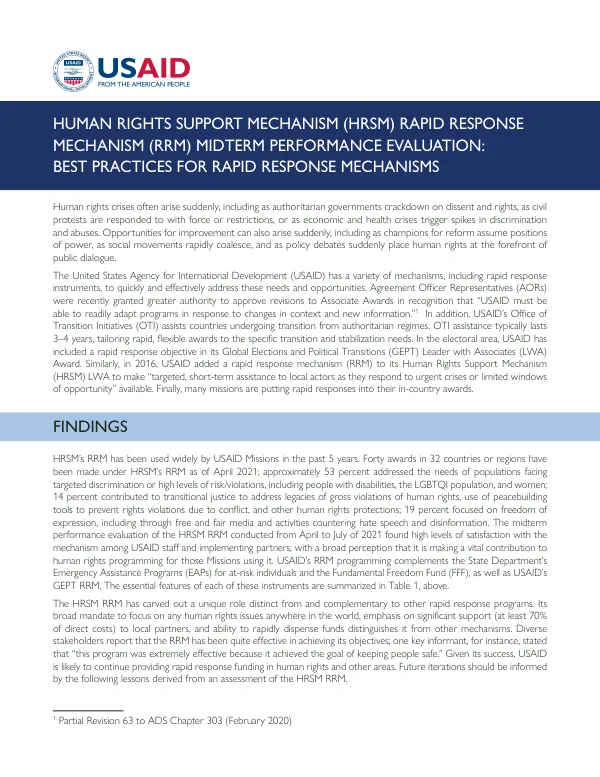
HRSM RRM Midterm Performance Evaluation: Best Practices
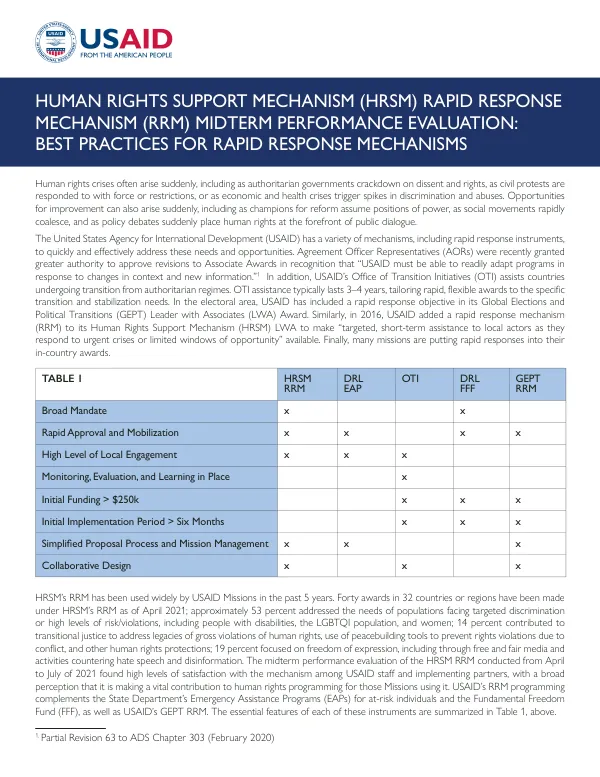
Human rights crises often arise suddenly, including as authoritarian governments crack down on dissent and rights, as civil protests are responded to with force or restrictions, or as economic and health crises trigger spikes in discrimination and abuses.
2021 · 2 pages
Sign in to readA free account is required to download.
Abstract
Opportunities for improvement can also arise suddenly, including as champions for reform assume positions of power, as social movements rapidly coalesce, and as policy debates suddenly place human rights at the forefront of public dialogue. The United States Agency for International Development (USAID) has a variety of mechanisms, including rapid response instruments, to quickly and effectively address these needs and opportunities. Agreement Officer Representatives (AORs) were recently granted greater authority to approve revisions to Associate Awards in recognition that USAID must be able to readily adapt programs in response to changes in context and new information. In addition, USAID's Office of Transition Initiatives (OTI) assists countries undergoing transition from authoritarian regimes. USAID's Human Rights Support Mechanism (HRSM) Rapid Response Mechanism (RRM) has been used widely by USAID Missions in the past 5 years. Forty awards in 32 countries or regions have been made under HRSM's RRM as of April 2021. Approximately 53 percent of these awards addressed the needs of populations facing targeted discrimination or high levels of risk/violations, including people with disabilities, the LGBTQI population, and women. The midterm performance evaluation of the HRSM RRM conducted from April to July of 2021 found high levels of satisfaction with the mechanism among USAID staff and implementing partners. The HRSM RRM has carved out a unique role distinct from and complementary to other rapid response programs. Its broad mandate to focus on any human rights issues anywhere in the world, emphasis on significant support (at least 70% of direct costs) to local partners, and ability to rapidly dispense funds distinguishes it from other mechanisms. Diverse stakeholders report that the RRM has been quite effective in achieving its objectives. Future iterations of the HRSM RRM should be informed by the following lessons derived from an assessment of the mechanism. First, promote locally led activities by ensuring that local entities are involved in the design process of rapid response efforts. Second, ensure Missions know about RRMs by making them well known to Missions, which will help USAID respond to localized crises where the needs/opportunities are significant, but that are less likely to attract other funding. Third, clarify parameters for RRM awards by defining "action-forcing events" and using practical restrictions such as monetary caps, limitations on the period of performance, or an absence of alternative funding to ensure RRM allocations are used most effectively over time. Fourth, intentionally allow for extensions by giving Missions and stakeholders the ability to quickly evaluate the efficacy of the activities and consider whether the need persists before committing additional funds. Fifth, tailor reporting and record-keeping requirements to programmatic needs by using regular reporting to document implemented activities and keep USAID abreast of a dynamic context. Sixth, include monitoring, evaluation, and learning to the extent possible by conducting after-action reviews and using contemporaneous and secure data collection to inform USAID's Collaborating, Learning, and Adapting models. Finally, continuously coordinate with donors by monitoring other programs to avoid redundancy and checking with DRL before initiating a new RR activity.