USAID DEC
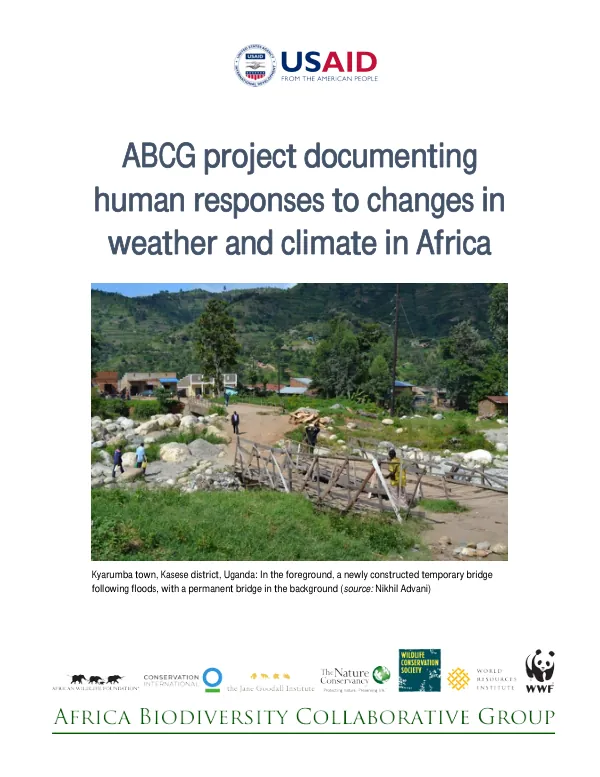
Human Responses to Changes in Weather and Climate in Africa: Kyarumba Town, Kasese District, Uganda
Sign inAFRICAN BIODIVERSITY COLLABORATIVE GROUP
Human Responses to Changes in Weather and Climate in Africa: Kyarumba Town, Kasese District, Uganda
The Africa Biodiversity Collaborative Group (ABCG) comprises seven international conservation NGOs with the goal of working collaboratively to further a sustainable future for the African continent.
2015 · 34 pages
Sign in to readA free account is required to download.
Abstract
The Climate Change Working Group, consisting of Conservation International, The Nature Conservancy, Wildlife Conservation Society, and World Wildlife Fund, investigated the effects of climate change in four countries: Gabon, Madagascar, Tanzania, and Uganda. This report documents the findings of qualitative research undertaken through interviews and focus groups in selected communities where Group members work. The primary data collection took place between May 2014 and March 2015, led by researchers from four of the seven ABCG members. A total of 28 interviews were conducted in Gabon, Madagascar, Tanzania, and Uganda, with interviewees engaged in various natural resource-based livelihoods, mainly farming and fishing. Two focus groups were also facilitated, one in Uganda and one in Madagascar. The locations, characteristics, and timing of this primary research are summarized in a table, which highlights the diversity of participants and research sites. Climate change in Africa is projected to have significant impacts on various sectors, including terrestrial ecosystems, freshwater ecosystems, coastal and ocean systems, water resources, agriculture, and health. Projected climate change trends in Africa include rising temperatures, changes in rainfall patterns, and increased frequency and severity of extreme events. These changes are expected to have far-reaching consequences for human populations and ecosystems. Observed changes and impacts in the study areas include temperature increases, changes in rainfall patterns, and increased frequency and severity of extreme events. These changes have significant implications for human livelihoods, particularly for communities dependent on natural resources. The study found that communities are responding to these changes through various coping strategies, reactive adaptations, and anticipatory adaptations. Coping strategies include short-term measures to mitigate the effects of climate change, such as changing farming practices or diversifying livelihoods. Reactive adaptations involve longer-term responses to observed changes, such as conservation agriculture and land management. Anticipatory adaptations involve planning for future changes, such as investing in improved technology or social protection programs. Barriers to adaptation include lack of access to finance and credit, lack of access to information and technical know-how, and land tenure systems. To support local adaptation, recommendations include improving access to finance and credit, enhancing access to information and technical know-how, and addressing land tenure issues. By understanding these barriers and recommendations, policymakers and practitioners can support communities in adapting to climate change and promoting sustainable development.
Related documents