USAID
Human Rights Compass
The USAID Human Rights Program in Colombia has been instrumental in advancing human rights and promoting equality for marginalized communities.
2014 · 4 pages
Sign in to readA free account is required to download.
Abstract
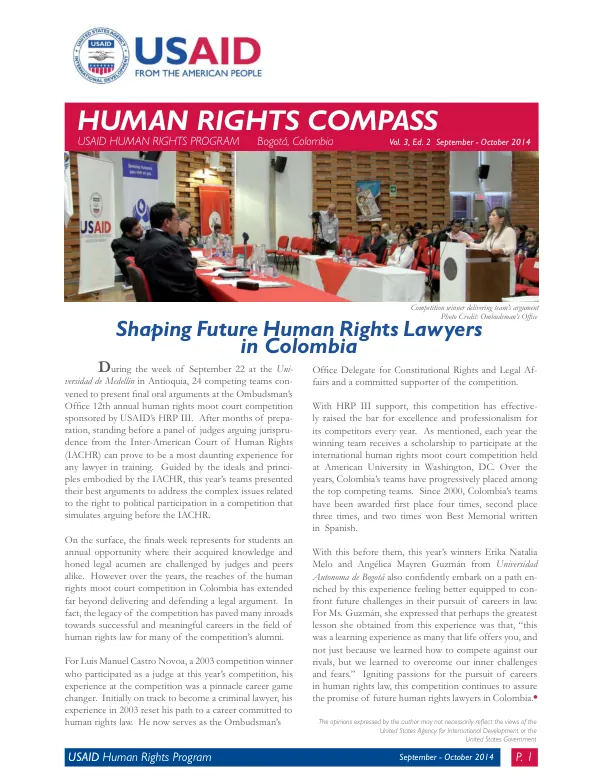
The program has supported various initiatives, including the annual human rights moot court competition, which brings together students from across the country to compete in a simulated trial before the Inter-American Court of Human Rights. The competition has become a premier event in the field of human rights law, with teams from Colombia consistently placing among the top competitors. The competition has also had a lasting impact on the careers of its alumni, with many going on to become prominent human rights lawyers and advocates. For example, Luis Manuel Castro Novoa, a 2003 competition winner, credits the experience with changing his career path from criminal law to human rights law. He now serves as a judge at the competition and has become a leading figure in the field. In addition to the moot court competition, the USAID Human Rights Program has also supported efforts to advance LGBT rights in Colombia. The program has worked closely with Colombia Diversa, a leading LGBT advocacy group, to raise awareness and reduce violence and stigmatization of LGBT community members. In August 2014, the Constitutional Court of Colombia made a historic decision, ruling in favor of a same-sex couple's petition to adopt a child. This decision marked a significant step forward for LGBT rights in Colombia, although the road to full equality remains long and obstacle-filled. The program has also supported efforts to protect human rights defenders in Colombia, who face increasing threats and violence in the context of the country's ongoing conflict. According to a report by Somos Defensores, 194 human rights leaders were targeted with threats and/or acts of aggression in the first half of 2014, a 20% increase compared to the same period in 2013. The report highlights the need for greater protection and support for human rights defenders, who are often the target of intimidation and violence. In the context of the conflict, even innocuous youth development projects have become grounds for death threats. For example, Bernardo Cuero, a community leader from the Afro-Colombian advocacy group AFRODES, has been targeted with threats and personal attacks for his work with youth in the Malambo region. The program has supported efforts to protect human rights defenders like Cuero, who are working to create alternatives for Afro-Colombian youth facing bleak futures. The USAID Human Rights Program has also supported efforts to promote economic opportunities and reduce poverty in Colombia. The program has worked with local organizations to develop economic empowerment programs for marginalized communities, including Afro-Colombians and LGBT individuals. These programs aim to provide training and support for entrepreneurship and job creation, helping to reduce poverty and promote economic stability. Overall, the USAID Human Rights Program in Colombia has made significant contributions to advancing human rights and promoting equality for marginalized communities. The program's support for initiatives like the human rights moot court competition, LGBT rights advocacy, and human rights defender protection has helped to create a more just and equitable society in Colombia.
Related documents