MANAGEMENT SYSTEMS INTERNATIONAL
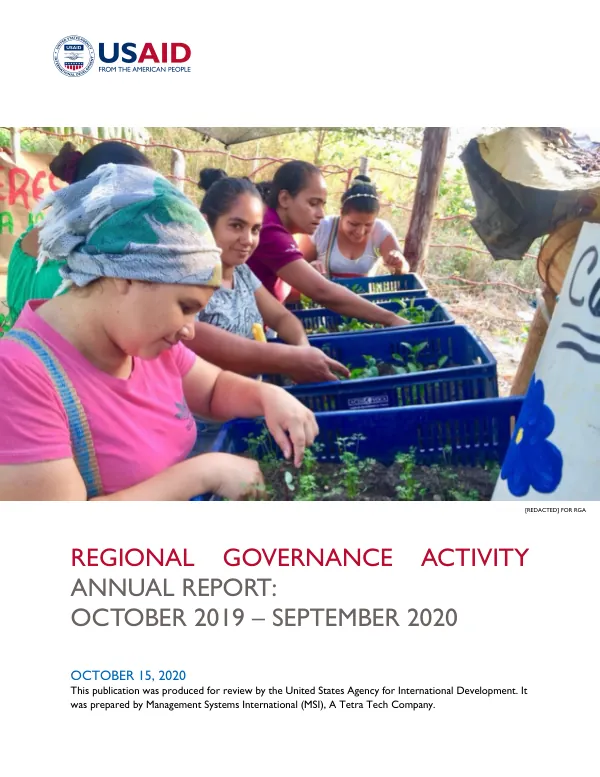
Annual Report: October 2019 – September 2020
The Regional Governance Activity (RGA) in Colombia aimed to strengthen subnational governance and improve the delivery of public services.
2020 · 103 pages
Sign in to readA free account is required to download.
Abstract
The activity began in 2015 and was contracted under the Programming Effectively Against Conflict and Extremism (PEACE) IQC, Task Order No. AID-514-TO-15-00015. The RGA was implemented by Management Systems International (MSI), a Tetra Tech Company, in partnership with the Government of Colombia (GOC) and other stakeholders. The RGA focused on improving governance and public service delivery in 12 target municipalities, with a particular emphasis on addressing the needs of vulnerable populations, including women, children, and internally displaced persons. The activity implemented a range of interventions, including support for citizen oversight groups, risk management strategies, and health care access initiatives. One of the key components of the RGA was the establishment of citizen oversight groups, known as Juntas de Acción Comunal (JACs), which aimed to promote citizen participation and engagement in local decision-making processes. The JACs were established in 12 municipalities and were supported by the RGA through training, technical assistance, and capacity-building activities. The RGA also implemented a range of health care access initiatives, including support for the Local Health System Sustainability Program (LHSS) and the Plan Territorial de Salud (PTS). These initiatives aimed to improve access to health care services for vulnerable populations, including women, children, and internally displaced persons. In addition to these initiatives, the RGA also supported the development of risk management strategies, including the establishment of a Sala de Análisis de Riesgo (SAR) in each of the 12 target municipalities. The SARs aimed to promote a culture of risk management and to support the development of effective risk management strategies at the local level. The RGA also worked closely with the GOC and other stakeholders to support the implementation of the Plan de Desarrollo Departamental (PDD) and the Plan de Desarrollo Municipal (PDM). These plans aimed to promote economic growth, social development, and environmental sustainability at the local level. Throughout the reporting period, the RGA made significant progress in achieving its objectives, including the establishment of 12 JACs, the implementation of health care access initiatives, and the development of risk management strategies. The activity also supported the development of a range of technical documents, including the Plan Territorial de Salud (PTS) and the Plan de Acción en Salud Transitorio (PAS). The RGA also faced a number of challenges during the reporting period, including the COVID-19 pandemic, which had a significant impact on the activity's implementation. However, the RGA was able to adapt to these challenges and continue to make progress in achieving its objectives. Overall, the RGA made significant contributions to the strengthening of subnational governance and the improvement of public service delivery in Colombia. The activity's focus on addressing the needs of vulnerable populations, including women, children, and internally displaced persons, was particularly noteworthy.