INSPECTOR GENERAL’S OFFICE
Human Rights Compass
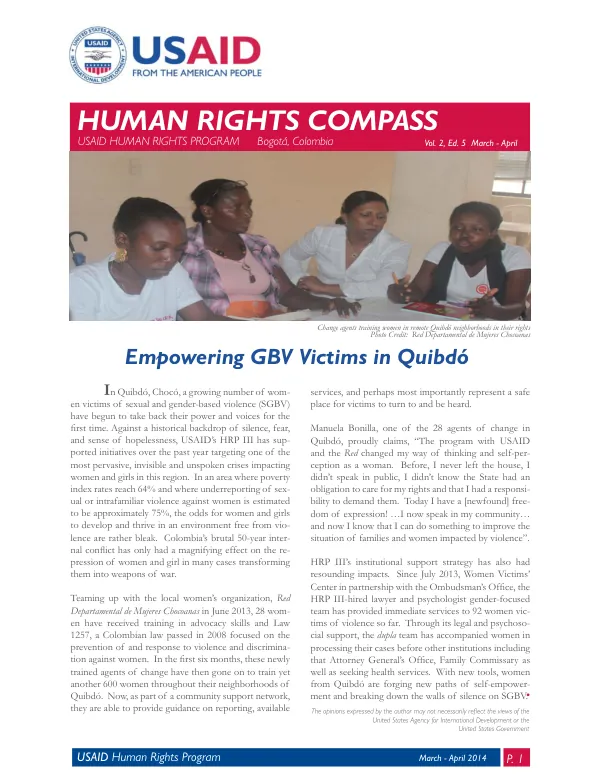
The Human Rights Program (HRP) III in Colombia has been working to address the pervasive issue of sexual and gender-based violence (SGBV) in the region of Quibdó, Chocó.
2014 · 4 pages
Sign in to readA free account is required to download.
Abstract
This area has historically been marked by silence, fear, and a sense of hopelessness, with a poverty index rate of 64% and an estimated 75% underreporting of SGBV cases. The Colombian government's 50-year internal conflict has further exacerbated the repression of women and girls, often transforming them into weapons of war. In response to this crisis, HRP III has supported initiatives targeting SGBV in Quibdó. In June 2013, 28 women received training in advocacy skills and Law 1257, a Colombian law focused on preventing and responding to violence and discrimination against women. These women, known as agents of change, have since trained over 600 women in their neighborhoods, providing guidance on reporting and available resources. They have also established a community support network, empowering women to take back their power and voices. The Women Victims' Center, in partnership with the Ombudsman's Office and a HRP III-hired lawyer and psychologist team, has provided immediate services to 92 women victims of violence since July 2013. Through legal and psychosocial support, the team has accompanied women in processing their cases before other institutions, including the Attorney General's Office and Family Commissary. This support has helped women from Quibdó forge new paths of self-empowerment and break down the walls of silence on SGBV. In addition to addressing SGBV, HRP III has also supported Colombia's Inspector General's Office (IGO) in improving oversight of government agencies carrying out intelligence and counterintelligence duties. This initiative has involved an international study tour to Guatemala and Spain, where countries with vast experience in archives and intelligence management shared best practices. The IGO has also organized an international dialogue, bringing together international counterparts, civil society, and government institutions to regroup on lessons learned and exchange perspectives. The IGO's role in defining the management of intelligence files places it in a unique position to provide sound recommendations on this matter. The Colombian government's task goes beyond just organizing and defining the management of its intelligence archives, as many of its files amount to piles of documentation that remain to be deciphered and analyzed. The IGO's leadership in this process has been critical in providing a long-term vision towards a democracy that is accessible to its citizens. In the Montes de Maria region of Colombia, one of the most conflict-affected regions, HRP III has begun to pave paths of access responding to the needs of a widespread victim population. The Universidad de Cartagena's satellite legal clinic, inaugurated in December 2013, has provided legal and psychosocial support to over 380 victim cases. The clinic has rapidly become synonymous as a center for guidance, advice, support, and hope for this largely isolated population. As part of its outreach strategy, the clinic has carried out a mobile day of services to the nearby municipality of San Jacinto, successfully registering 58 cases of 61 community members in one day alone.