MERCY CORPS INTERNATIONAL
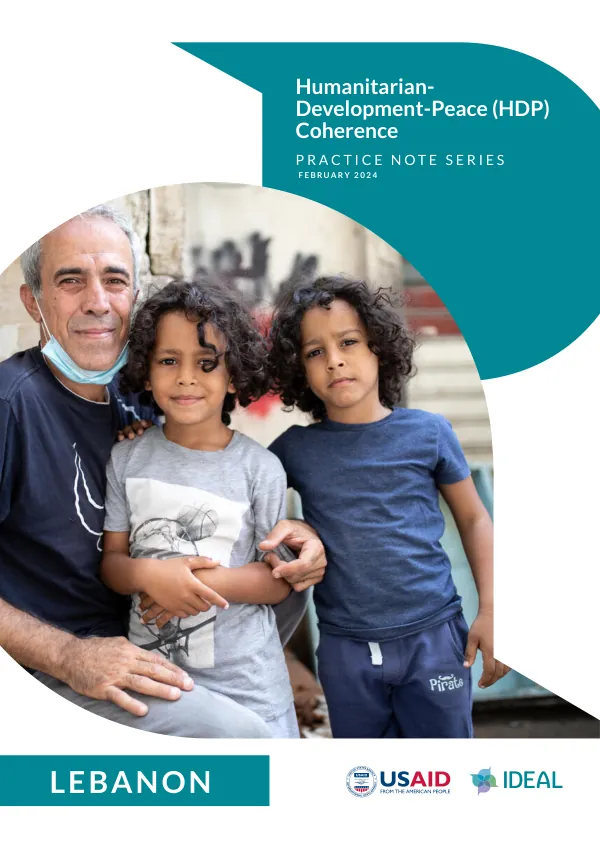
Humanitarian-Development-Peace (HDP) Coherence Practice Note Series: Lebanon
Humanitarian-Development-Peace (HDP) Coherence in Lebanon The HDP Coherence Practice Note Series, published by the Implementer-Led Design, Evidence, Analysis and Learning (IDEAL) activity, explores the operationalization of one of the HDP principles in the context of Lebanon.
2024 · 18 pages
Sign in to readA free account is required to download.
Abstract
The note describes how Mercy Corps' experience implementing shock-responsive programming and data-driven adaptive management (HDP Principle 5) was underpinned by three key practices. Recurrent risk analysis for data-driven adaptive management has proven essential for informing data-driven adaptive management. Mercy Corps Lebanon relied on timely and comprehensive contextual analysis to make informed decisions and propose shifts in their programming. By analyzing primary and secondary data from sources across the humanitarian and development spectrum, Mercy Corps was able to identify vulnerabilities and impacts at various levels—from households to market systems. Joint design of programming pivots emphasized the importance of involving expertise from both humanitarian and development sectors. By bringing together multidisciplinary teams and engaging in regular meetings, Mercy Corps Lebanon fostered collaboration, avoided siloed responses, and designed emergency responses that connected to development outcomes. This approach allowed them to maintain a balance between addressing immediate needs and mitigating risks to undermine past investments. Leveraging existing funding flexibility and partnerships enabled Mercy Corps Lebanon to adjust its development programming to quickly respond to shocks. The team utilized existing funds and sought permission from donors to adjust programming, demonstrating the importance of flexibility within funding agreements. Leveraging partnerships and consortia proved to be efficient, especially in the aftermath of a shock, as it allowed for faster assessments and broader geographical coverage. The implementation experience of Mercy Corps Lebanon demonstrates how shock-responsive programming and data-driven adaptive management can support an HDP-coherent approach to addressing the complex challenges of an increasingly shock-affected environment. By conducting recurrent risk analysis, engaging in joint program design, and leveraging existing resources and partnerships, Mercy Corps Lebanon ensured its current funding could swiftly adjust to respond to rising needs to support food security, livelihoods, and other necessities. USAID's Humanitarian-Development-Peace (HDP) Coherence Principles were published in January 2022, following extensive internal and partner consultations. The document identifies seven core principles, one cross-cutting commitment, and programming examples to improve HDP coherence and achieve common objectives. The principles are: Uphold and respect humanitarian principles, Plan jointly and seek a common agenda, Create and strengthen communication, coordination, and learning platforms, Strategically sequence, layer, and integrate humanitarian, development, and peace assistance, Promote shock-responsive programming and data-driven adaptive management, Champion conflict integration and opportunities for enabling or building peace, and Ensure programming is with, by, and through local partners and systems. Underpinning each of these key principles is USAID's cross-cutting commitment to gender equality and inclusive development. Diversity, equity, inclusion, and access are at the heart of USAID's mission. The HDP Coherence Practice Note Series responds to a demand among food and nutrition security practitioners for clear examples of HDP coherence in practice. The series aims to increase knowledge and capacity and create inspiration among USAID implementing partners and other organizations by providing practical examples of how USAID's HDP coherence principles are being operationalized to maximize food and nutrition security outcomes. The HDP Coherence Practice Note Series presents a concise and operationally focused example of one or more of the HDP coherence principles "in action" and draws out lessons learned that may be applicable in other contexts. Examples include HDP coherence approaches within a single activity (intra-activity), between separate humanitarian and development activities (inter-activity), or within a single organization (intra-organization).
Related documents
Documents in this collection
 2021
2021USAID DEC
Building Alliances for Local Advancement, Development and Investment – Capacity Building (BALADI CAP) Quarterly Progress Report – Fiscal Year 2021 Quarter 1
Open record 2021
2021USAID DEC